








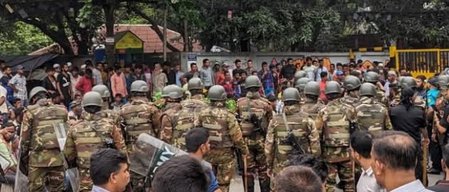
Bangladesh is witnessing a fresh wave of student-led protests as thousands of agricultural diploma students launched the ‘Agri Blockade’ programme on Monday, demanding reforms in higher education access and employment policies. Demonstrators under the banner of the Agricultural Diploma Student Rights Movement staged a sit-in at Khamarbari in Dhaka, effectively blocking all entrances to the Department of Agricultural Extension (DAE).
The protest severely disrupted operations at the DAE, with employees unable to access the premises and traffic in the surrounding area brought to a standstill. Law enforcement and military personnel were deployed and remain on high alert.
The agitation follows a similar rally held on Sunday at the National Shaheed Minar in Dhaka, where students from across the country gathered to voice their concerns. According to The Dhaka Tribune, nearly 2,000 students participated in Monday’s blockade. The broader movement involves approximately 25,000 students enrolled in four-year diploma programmes across 18 government-run Agricultural Training Institutes and 260 private colleges.
Speaking to the media, student leader Asaduzzaman Abir said, “Diploma students in agriculture face systemic discrimination in terms of access to higher education and employment. Our demands are rooted in equity and educational justice.”
The students have outlined a series of nine key demands, including:
The right for diploma graduates to pursue higher education at public agricultural universities.
A resolution to the chronic shortage of qualified teachers in diploma institutions.
Transfer of administrative oversight of diploma agricultural education from the DAE to the Ministry of Agriculture.
Improved job placement, salary structures, and professional allowances for diploma holders.
In a related development, students from polytechnic institutes have also intensified their protests in recent days, staging demonstrations in multiple cities and blocking highways and railway lines. These students have raised a six-point demand, including an end to recent violent crackdowns against demonstrators.
The surge in student activism comes amid increasing social unrest and a deteriorating law and order situation under the interim government led by Nobel laureate Muhammad Yunus. Observers note that the protests reflect broader dissatisfaction with the country’s education and employment policies, particularly among technical and vocational student groups.
As the demonstrations continue, stakeholders are calling for immediate dialogue between student representatives and government officials to prevent further escalation and to ensure that the voices of the youth are adequately addressed in policy reforms.
Recent Random Post: