









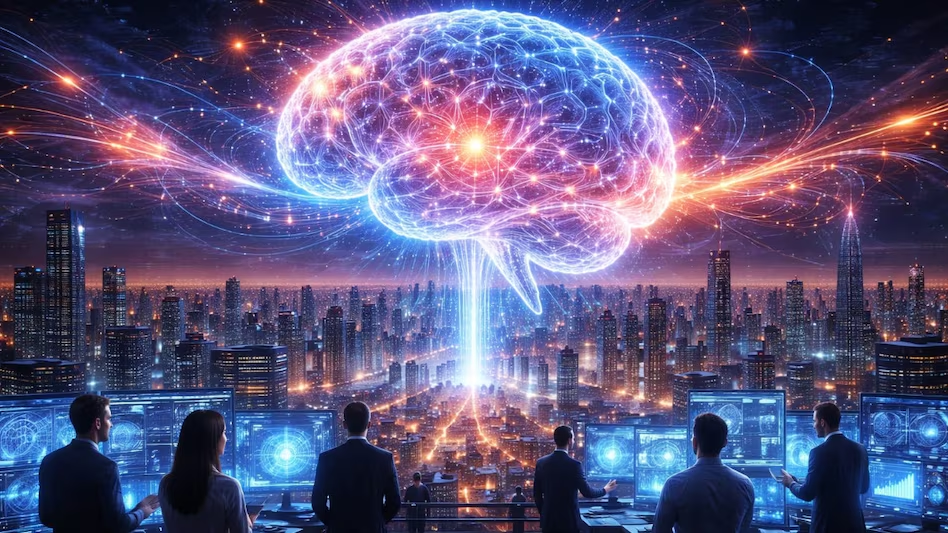
That’s the stark warning from Matt Shumer, co-founder and CEO of OthersideAI, the company behind the AI autocomplete tool HyperWrite. In a widely shared post titled “Something Big Is Happening”, Shumer likened the current AI moment to early February 2020, when most people dismissed warnings about COVID-19. “I think we’re in the ‘this seems overblown’ phase of something much, much bigger than Covid,” he wrote.
Shumer emphasizes that even industry insiders underestimated how quickly AI would shift from incremental improvements to exponential leaps. “For years, AI had been improving steadily. Then in 2025, new techniques for building these models unlocked a much faster pace of progress. And then it got even faster. And then faster again.”
A turning point, he says, came on February 5, 2026, with the release of flagship models like GPT-5.3 Codex from OpenAI and Opus 4.6 from Anthropic. “I am no longer needed for the actual technical work of my job,” Shumer explained. “I describe what I want built, in plain English, and it just… appears. Not a rough draft I need to fix. The finished thing.” He claims he now delegates complex development tasks to AI systems that execute, test, and refine outputs independently. “I tell the AI what I want, walk away for four hours, and come back to find the work done. Done well, done better than I would have done it myself, with no corrections needed.”
Perhaps most striking is AI’s ability to improve itself. Shumer highlighted that GPT-5.3-Codex has been instrumental in its own development, helping debug training processes, manage deployments, and evaluate results. “One of the main things that makes AI better is intelligence applied to AI development. And AI is now intelligent enough to meaningfully contribute to its own improvement,” he wrote.
Shumer also sounded a warning for the workforce. He referenced predictions from AI leaders, including Anthropic CEO Dario Amodei, that up to 50% of entry-level white-collar jobs could be disrupted within one to five years. “This is different from every previous wave of automation… AI isn’t replacing one specific skill. It’s a general substitute for cognitive work,” he said. Any role that involves reading, writing, analyzing, drafting, or coding is particularly at risk. “If your job happens on a screen… then AI is coming for significant parts of it.”
Beyond jobs, Shumer highlighted broader societal implications, including geopolitics and national security. He pointed out the potential upside, such as compressing a century of medical research into a decade, but also warned about risks like unpredictability and misuse. “The people building this technology are simultaneously more excited and more frightened than anyone else on the planet,” he noted.
He concluded with a stark message: “We’re past the point where this is an interesting dinner conversation about the future. The future is already here. It just hasn’t knocked on your door yet. It’s about to.”
Recent Random Post: