









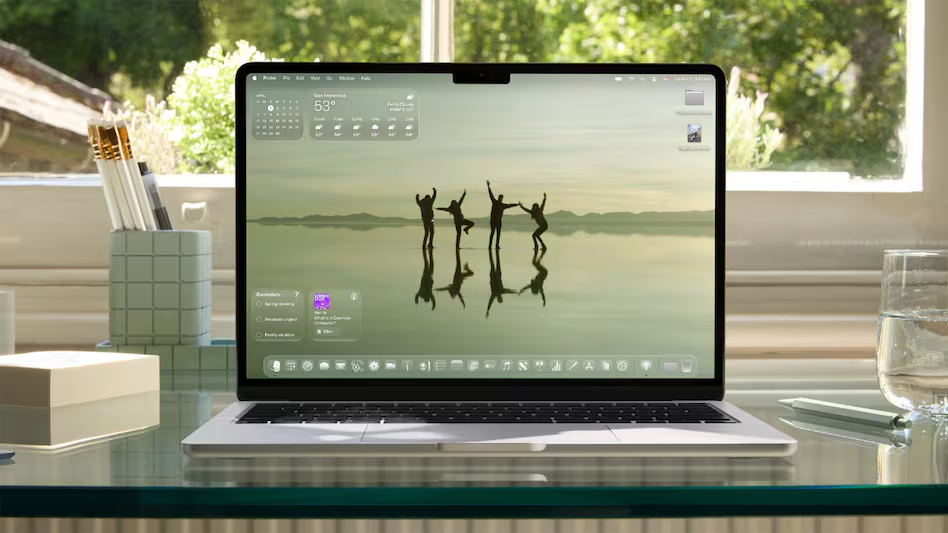
Apple has officially confirmed that macOS Tahoe will be the final major software update for Intel-based Macs. The announcement came during the WWDC 2025 Platforms State of the Union event, where Matthew Firlik, Apple’s Senior Director of Developer Relations, stated the company’s complete shift toward Apple silicon. Emphasizing the capabilities unlocked by Apple’s custom chips, Firlik urged developers to transition their apps fully to Apple silicon, highlighting that now is the right time to help users make that move.
Apple’s transition to Apple silicon began in 2020 and was completed in 2023 with the release of the Apple silicon Mac Pro. Although support for Intel Macs has been gradually reduced over time, this announcement sets a definitive end to major feature support for Intel machines. macOS Tahoe, set for release later this year, will be the final macOS version to include new features for supported Intel models. These models — such as the 2019 16-inch MacBook Pro and the 2020 13-inch MacBook Pro with four Thunderbolt 3 ports — will continue receiving security updates for at least three more years, but will not get any new feature additions after this release.
macOS Tahoe introduces Apple’s new Liquid Glass design language, first seen in iOS 26. It also brings smarter Spotlight search, support for Live Activities, and for the first time, a native Phone app on the Mac. These features reflect deeper integration across Apple’s product ecosystem, made possible by the performance and efficiency of Apple silicon. The list of supported devices includes Apple silicon models across the MacBook Air, MacBook Pro, iMac, Mac mini, Mac Studio, and Mac Pro lines, alongside a few last-generation Intel Macs that will be included in this final major release.
This marks a significant turning point for the Mac platform. While Intel Macs will continue to receive security patches, they will no longer be part of Apple’s innovation roadmap. With macOS Tahoe, Apple signals that the future of Mac computing will be entirely driven by its own chip architecture, closing the chapter on Intel’s era within the Mac ecosystem.
Recent Random Post: