







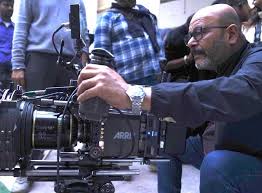
Cinematographer Aseem Bajaj, with over three decades of experience, has built a reputation for creating visuals that are both emotionally rich and aesthetically powerful. In an exclusive chat with DC, he reflects on his journey, the collaborative nature of filmmaking, and his instinctive approach to the craft.
Interestingly, Bajaj’s path to cinematography was accidental. Initially drawn to music and theatre, he found himself interning on the film Bandit Queen thanks to casting director Tigmanshu Dhulia. That three-month stint became a turning point. After completing the project, Bajaj moved to Mumbai with Dhulia and began assisting seasoned cinematographers like Santosh Chavan, Madhu Ambat, and Vinod Pradhan. He considers their mentorship a blessing, shaping his foundation in visual storytelling.
For Bajaj, cinematography is not about imposing his own vision but about bringing the director’s story to life. He believes his job is to be an extension of the director’s vision. Every project changes based on the director’s tone, voice, and emotional language. That’s why no two films look the same in his body of work. His respect for actors also stands out—he sees them as emotionally vulnerable artists who need to be supported, not just framed. Growing up in a theatre-influenced household, where his father was a director at the National School of Drama, deepened his empathy for actors and performers.
Despite having no formal training in cinematography, Bajaj never saw that as a limitation. He believes learning comes from observing life—how light falls, how people feel, how emotions unfold in real time. These real-world observations guide his creative choices far more than textbooks or technical manuals. To him, cinematography is about presence and human connection more than camera specs.
Talking about his recent work on Son of Sardar 2, he opened up about the challenges of shooting in Scotland, especially with its unpredictable weather. The fluctuating light conditions made maintaining visual continuity over five days particularly difficult. However, the film, being a family-oriented comedy, didn’t rely heavily on visual effects or complex technical layers. Bajaj shares a special bond with the film’s director, Vijay Arora, who was once his mentor. That personal history made the project even more meaningful. The film also stood out for its sensitive portrayal of the female lead, played by Mrunal Thakur, something Bajaj hopes will be appreciated for going beyond superficial comedy.
While many in the industry obsess over keeping up with the latest tech trends, Bajaj remains grounded in emotion. For him, terms like 2K, 4K, or 8K are secondary. What matters is human emotion, which remains unchanged over the years. He believes the actor is his primary tool—not the camera. Whether he’s filming on a smartphone or a top-tier setup like Sony Venice, his focus is always on capturing the soul of a scene.
Despite his experience, Bajaj continues to evolve. He even took a one-year sabbatical to train in the U.S. with IMAX Corporation, learning advanced techniques like 3D cinematography from the Avatar 2 team. Still, he emphasizes that technical prowess should never overshadow storytelling. Often in India, cinematographers don’t get the script in advance, forcing them to rely on intuition and emotional instinct during shooting. That raw, unfiltered connection with the scene drives his work.
Even after 33 years in the field, Bajaj admits he still feels nervous before every shot. He believes that uncertainty is what keeps him creatively alive. Learning, he says, is a constant process—sometimes from his team, sometimes from the actors, and often from his own mistakes. He doesn’t see himself as a master but as someone still discovering new ways to express emotions through visuals. His emotional involvement is so deep that he often tears up behind the camera, completely immersed in the story unfolding in front of him.
In a world driven by visual flair and technical wizardry, Aseem Bajaj stands out for his emotional sincerity and artistic humility. His work reminds us that at its heart, cinema is not about tools or techniques, but about truth—and the people who dare to feel it.
Recent Random Post:
Moinabad Farmhouse Drug Case | ఫామ్ హౌస్ లో తీగ లాగితే.. దుబాయ్ లో కదిలింది డొంక
Moinabad Farmhouse Drug Case | ఫామ్ హౌస్ లో తీగ లాగితే.. దుబాయ్ లో కదిలింది డొంక