









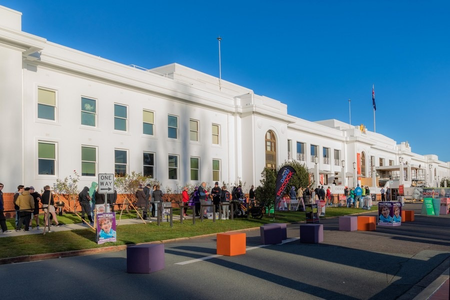
Early voting commenced across Australia on Tuesday, ahead of the federal general election scheduled for May 3. Approximately half of the country’s 18 million registered voters are expected to cast their ballots before election day, reflecting a growing trend toward early participation.
More than 500 early voting centres opened nationwide at 8:30 a.m. local time, as the election campaign entered its critical final phase. The Australian Electoral Commission (AEC) confirmed that voter enrolment for the upcoming election has reached a record 98.2 per cent of eligible citizens aged 18 and over, underlining robust civic engagement in a country where voting is compulsory.
The popularity of early voting has surged in recent decades, increasing from less than 20 per cent in 2004 to nearly 50 per cent by 2022. Analysts, including Jill Sheppard from the Australian National University, attribute this rise to the convenience of pre-polling and a growing sense of disengagement from traditional political campaigning.
Despite millions of Australians voting early, electoral staff are not permitted to begin counting any ballots until the official close of polls at 6 p.m. local time on election day.
As the campaign heats up, Prime Minister Anthony Albanese emphasized that the election remains “up for grabs,” cautioning against complacency despite a series of favorable opinion polls. Labour, which currently holds 77 seats in the 150-member House of Representatives, appears to be in a strong position to secure a second term.
A Newspoll released Sunday reported a 52–48 lead for Labour over the opposition Coalition on a two-party preferred basis. Similarly, a separate YouGov poll indicated a 53–47 advantage for Labour — the party’s strongest performance in the firm’s polling since late 2023.
However, both parties remain cautious. Albanese referenced the surprise 2019 election result, where the Coalition defied polling predictions to secure victory, as a reason to avoid overconfidence. Echoing that sentiment, Opposition Leader Peter Dutton highlighted voter unpredictability, pointing to the Coalition’s unexpected win in 2019 as a precedent for optimism.
Dutton also outlined a $750 million (AUD) policy pledge to crack down on crime, including the establishment of a national sex offender registry, as part of the Coalition’s campaign strategy.
Australians vote using a preferential system, ranking candidates in order of preference within their local electorates. If no candidate secures an outright majority of first preference votes, the lowest-ranked candidates are eliminated and votes are redistributed according to voter preferences — a system that has historically benefited Labour due to strong support from Greens voters.
In the 2022 general election, Labour secured 52.13 per cent of the two-party preferred vote, despite receiving fewer first preference votes than the Coalition. The current election is being contested in all 150 electorates, some featuring up to 13 candidates, underscoring the diversity and competitiveness of the electoral landscape.
As the nation edges closer to May 3, early voting is expected to play a pivotal role in shaping the outcome of one of Australia’s most closely watched elections in recent history.
Recent Random Post: