








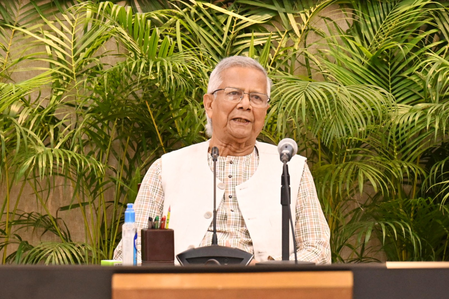
Confronting mounting political tensions and a deepening national crisis, Bangladesh’s interim government, led by Chief Advisor Muhammad Yunus, has alleged that “defeated forces” and a “foreign conspiracy” are actively working to undermine the administration’s efforts, creating widespread confusion and hampering its ability to function effectively.
Yunus, who chaired an unscheduled two-hour meeting of the Advisory Council on Saturday at the Planning Commission office in Dhaka, addressed the nation’s increasingly volatile political landscape. The meeting was convened as speculation intensified regarding the stability of the interim government and Yunus’s own position, amid reports that he had considered stepping down.
In a strongly worded statement following the meeting, the Advisory Council said, “Despite all obstacles, the Interim Government continues to fulfil its responsibilities by placing national interest above partisan concerns. However, if — under the instigation of defeated forces or as part of a foreign conspiracy — these responsibilities become impossible to execute, the government will present all reasons to the public and take appropriate steps with the people’s support.”
The council criticized what it termed as “unreasonable demands, jurisdictionally overreaching statements, and disruptive programmes” that have obstructed governance and sowed public distrust. The statement underscored the government’s commitment to its three primary responsibilities: ensuring free and fair elections, implementing reforms, and upholding justice.
The meeting of the Executive Committee of the National Economic Council also reviewed these mandates in detail. The Council emphasized that national stability and the prevention of authoritarian resurgence require broad political unity.
“The Advisory Council believes that a broader unity is essential to maintain national stability, organise free and fair elections, deliver justice, and enact reforms,” the statement added. “On these matters, the Interim Government is open to listening to the views of political parties and will clarify its own position.”
Amid escalating pressure from key political actors, including the Bangladesh Nationalist Party (BNP) and the newly formed National Citizen Party (NCP), there have been growing calls for a clear electoral roadmap. In response, Planning Advisor Wahiduddin Mahmud told local media, “We are not going anywhere until our job is done. The future of the country depends on our work. We cannot abandon this responsibility.”
Simultaneously, meetings between Yunus and leaders from BNP and Bangladesh Jamaat-e-Islami were confirmed by the Chief Advisor’s press wing. These discussions are aimed at defusing political tensions and navigating a path forward. BNP leaders stated they would press Yunus to announce an election roadmap within 2025 and accelerate the reform process.
Political unrest, rising crime, and public protests have marred the interim government’s tenure since its inception in August 2024. The BNP has warned of intensified street demonstrations if a timeline for elections is not announced soon.
In a related development, Bangladesh Army Chief General Waker-Uz-Zaman reiterated that the national election must be held by December 2025, with a democratically elected government in place by January 1, 2026.
The coming weeks are expected to be critical in shaping Bangladesh’s democratic future, as the interim administration navigates increasing domestic and international pressure to ensure a transparent and timely electoral process.
Recent Random Post: