









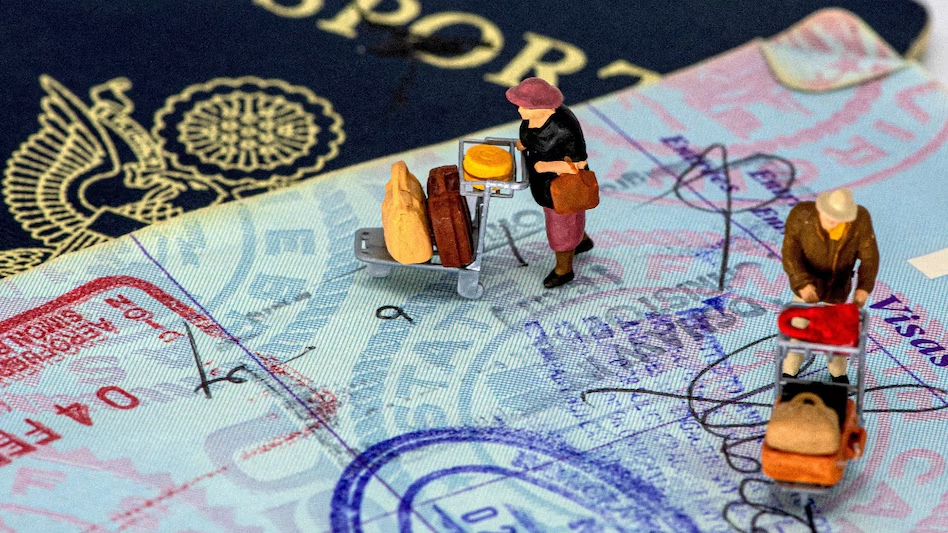
For years, global travel discussions have focused on “passport strength.” But for Indian travellers, the more practical question is not where they can go on paper — it’s where they can realistically plan, book and travel to without running into unnecessary hurdles.
A new 2026 Travel Access Report by visa processing platform Atlys shifts the focus from diplomatic mobility to real-world accessibility. Instead of relying solely on passport rankings, the report evaluates 50 international destinations based on how easy they are for Indian passport holders to access. It factors in visa processes, flight connectivity, affordability and actual travel demand.
This approach contrasts with the Henley Passport Index, where the Indian passport currently ranks 80th globally, offering access to 55 destinations visa-free, visa-on-arrival or via ETA — an improvement of five places since January 2025. While that index measures government-level agreements, the Atlys report attempts to capture the lived experience of travellers.
The access lens matters at a time when India’s outbound travel is expanding rapidly. According to the Ministry of External Affairs, 14.65 million passports were issued in 2024. Government data also recorded 28.10 million international departures in 2023 and 29.14 million departures through 8 December 2024. However, rising numbers do not necessarily mean seamless travel. Many travellers still face procedural delays, complex documentation requirements and high costs that go beyond passport rankings.
Mohak Nahta, Founder and CEO of Atlys, said the gap between aspiration and access is visible in travel data. “Indian travellers often choose between the destination they dream about and the destination they can actually access. We see destinations with high search interest that don’t convert into visa applications because friction discourages travellers midway. The Travel Access Report aims to highlight those barriers upfront.”
The ranking of 50 destinations is based on four weighted pillars: Popularity (35%), which considers search trends and booking volumes; Connectivity (25%), including direct flights and convenience; Visa ease (25%), covering approval rates and process complexity; and Affordability (15%), assessing cost of stay. The analysis combines visa processing insights, airline schedules, cost-per-day data and booking demand patterns.
Asian destinations dominate the top of the 2026 ranking. According to Atlys data, Sri Lanka, Thailand and the United Arab Emirates take the top three spots, followed by Nepal, Indonesia, Malaysia, Vietnam, Maldives, Oman and Mauritius. Strong air connectivity, relatively simpler entry requirements and lower travel costs give South and Southeast Asian countries a clear edge.
In contrast, European and North American destinations such as France, Germany, the United Kingdom and the United States remain highly aspirational but rank lower in practical accessibility. Visa complexity, longer processing timelines and higher overall trip costs reduce their access scores. Canada ranks at the bottom of the list at 50th, signalling that despite strong interest among Indian travellers, entry barriers have significantly impacted its practical accessibility.
The report also identifies leaders across different travel styles. For budget-friendly travel, Nepal, Laos, Sri Lanka, Thailand and Vietnam stand out. Impulse getaways are led by Nepal, Sri Lanka, Thailand, the UAE and Vietnam. In the luxury segment, Maldives, Switzerland, Fiji, France and Italy top the list. Thailand, the UAE, Japan, Hong Kong and Sri Lanka are among the most travelled destinations by women, while Thailand, Vietnam, Sri Lanka, Laos and Japan are rated best for solo travel.
Thailand, notably, appears across multiple categories — overall access, budget-friendly, women-friendly and solo-friendly — making it one of the most balanced and accessible international destinations for Indian tourists in 2026.
Recent Random Post: