









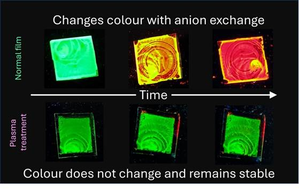
Researchers at the Centre for Nano and Soft Matter Sciences (CeNS) in Bengaluru, an autonomous institute under the Department of Science and Technology (DST), have developed an advanced method to minimise anion migration in CsPbX₃ perovskite nanocrystals. This breakthrough enhances their stability, reducing sensitivity to heat and moisture while ensuring colour consistency, making them more suitable for long-lasting optoelectronic applications.
Lighting technology has evolved significantly over the years, consuming nearly 20% of global electricity. From traditional incandescent and fluorescent lamps to the invention of LEDs in the 1960s, energy efficiency has improved dramatically. A major milestone came in 1993 when Shuji Nakamura and his team developed high-brightness blue LEDs, enabling energy-efficient white LEDs (WLEDs), a discovery that later earned the 2014 Nobel Prize in Physics.
Today, LEDs dominate the lighting market due to their efficiency and longevity, while OLEDs offer vibrant colours, and QLEDs (Quantum Dot LEDs) provide precise colour control and durability. Meanwhile, Micro/Mini-LEDs promise high brightness and stability but remain costly. Despite these advancements, challenges persist—OLEDs are expensive and have shorter lifespans, QLEDs contain toxic materials, and Micro/Mini-LEDs face high production costs.
Perovskite LEDs (PeLEDs) combine the best features of OLEDs and QLEDs, making them a promising alternative for next-generation lighting. However, their practical application has been hindered by heat and moisture sensitivity, along with colour instability caused by anion migration—where halide ions (chloride, bromide, or iodide) move between quantum dots in mixed layers.
To address this, Dr. Pralay K. Santra and his team at CeNS synthesized green light-emitting cesium lead bromide (CsPbBr₃) perovskite nanocrystals using a hot injection method, with oleylamine acting as the passivating ligand. They further enhanced stability through an argon-oxygen (Ar-O₂) plasma treatment, which immobilises surface ligands by forming a cross-linked, hydrophobic layer. This process effectively stabilises the ligands and slows anion exchange, dramatically improving colour stability.
The study, published in the journal Nanoscale, provides crucial insights into stabilising perovskite nanocrystals. This innovation paves the way for the development of efficient, durable optoelectronic devices with enhanced performance and reliability.
Recent Random Post: