







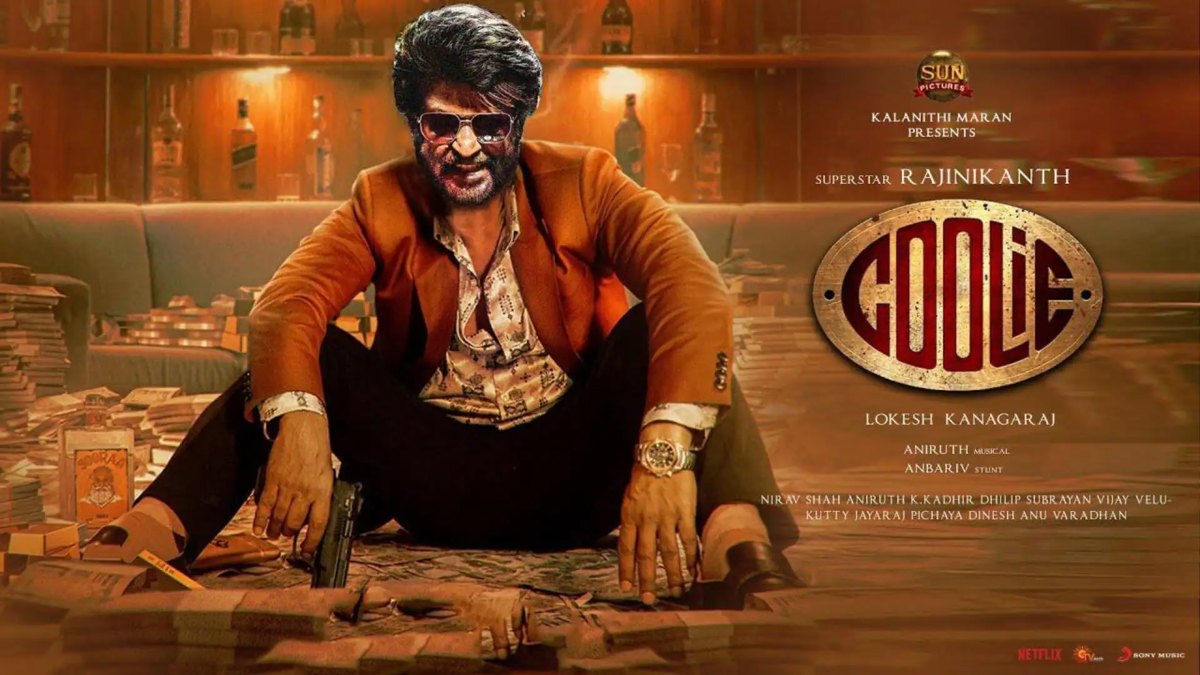
Rajinikanth’s Coolie, which opened to a thunderous ₹400 crore weekend, is now witnessing a sharp dip at the box office. Trade circles are increasingly doubtful about the film touching the coveted ₹1000 crore mark worldwide.
Producer Lagadapati Sridhar shared his perspective, saying, “The film opened big riding on Rajinikanth’s charisma, but it is losing momentum. To reach ₹1000 crore, it needs another ₹600 crore, which looks difficult at this stage. Still, we hope it manages.”
According to Sridhar, Coolie faltered on several fronts. “The friendship between Rajinikanth and Sathyaraj wasn’t convincingly portrayed by Lokesh Kanagaraj. The dated port backdrop reminded audiences of classics like Deewar. The ‘electric chair’ concept also failed to connect emotionally. Above all, the film lacked depth,” he explained.
He further pointed out that even acclaimed filmmakers have struggled in recent times: “Even directors like Shankar with Indian 2 and Mani Ratnam with Thug Life couldn’t achieve pan-India success.”
Interestingly, Rajinikanth himself had recently spoken about Lokesh Kanagaraj’s pan-India vision, which included uniting stars like Aamir Khan, Nagarjuna, Upendra, and Soubin Shahir. But Sridhar stressed that true pan-Indian success isn’t about multi-starrer casting. “It’s not just about bringing in stars from different languages; it’s about crafting an emotion-driven story that feels fresh and original,” he said.
Sridhar praised S. S. Rajamouli for setting the gold standard in pan-India cinema with Baahubali and RRR. “Rajamouli combines emotion and action seamlessly. For instance, in RRR, the opening action block with NTR and Ram Charan works because of the emotional bond with the child. Without that, it would’ve been just another stunt sequence,” he noted.
He contrasted Rajamouli’s world-building with Tamil filmmakers, whom he feels lean heavily on action without emotional grounding. “Rajamouli created a new folklore with kings and queens in Baahubali. RRR was rooted in the British Raj. Sukumar built the gritty red sanders world in Pushpa: The Rise. Nag Ashwin envisioned a futuristic dystopia in Kalki 2898 AD. These Telugu directors are ahead in creating unique cinematic worlds that resonate globally, and each film crossed ₹1000 crore,” Sridhar explained.
He added that Tamil directors often shine with stories rooted in their state, similar to Malayalam filmmakers who focus on local issues and characters. “Such films perform strongly on OTT and in their regions. But for theatres, audiences expect grandeur layered with emotion. Folklore epics like Baahubali, socio-fantasies like Kantara, mythological spectacles like Mahavir Narasimha, and underworld dramas like KGF have pan-India pull, while regional narratives thrive on streaming platforms,” he concluded.
Recent Random Post:
Ambati Rambabu Comments On Amaravati Construction | అమరావతి నిర్మాణంపై అంబటి కీలక వ్యాఖ్యలు
Ambati Rambabu Comments On Amaravati Construction | అమరావతి నిర్మాణంపై అంబటి కీలక వ్యాఖ్యలు