







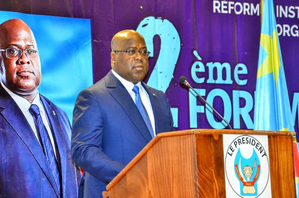
Kinshasa, Feb 24 (IANS) – The President of the Democratic Republic of the Congo (DRC), Felix Tshisekedi, has announced significant political and military reforms, including the formation of a “government of national unity,” to prevent the escalating security crisis in the eastern region from turning into a larger regional conflict.
A spokesperson for the presidency confirmed on social media platform X that Tshisekedi is moving towards reshaping the government and leadership within the Sacred Union, the ruling coalition comprising his Union for Democracy and Social Progress (UDPS) and allied parties.
During a high-level meeting with coalition members, the discussions centered on the deteriorating security situation in eastern DRC, where the March 23 Movement (M23) rebels have seized control of key cities, including Goma and Bukavu in North and South Kivu provinces.
Emphasizing the urgency of the situation, Tshisekedi stated that the country needs a “complete overhaul” of both political and military leadership, citing internal betrayals as a major challenge. He ruled out any direct negotiations with the M23 rebels, vowing to dismantle their influence.
The United Nations Security Council, in a resolution passed unanimously on Friday, called on the M23 rebels to halt their offensive immediately and urged Rwanda to withdraw its support for the armed group. The DRC accuses Rwanda of backing M23, while Rwanda, in turn, alleges that the Congolese army is collaborating with the Democratic Forces for the Liberation of Rwanda, a group linked to the 1994 Tutsi genocide.
Diplomatic efforts continue on multiple fronts, with the African Union (AU) recently calling for an “immediate and unconditional” ceasefire. However, peace talks remain stalled, as seen in December when a planned AU-led summit under the Luanda Process aimed at bringing Tshisekedi and Rwandan President Paul Kagame together was abruptly canceled.
The UN has warned that the DRC conflict poses a serious risk of regional spillover. Jean-Pierre Lacroix, UN Under-Secretary-General for Peace Operations, emphasized that the situation could escalate beyond the DRC’s borders. UN Secretary-General Antonio Guterres reiterated that military action alone cannot resolve the crisis and called for urgent dialogue.
The ongoing violence in eastern DRC, fueled by competition for control over valuable resources such as coltan, tin, tantalum, and gold, has triggered a massive humanitarian crisis. The UN High Commissioner for Refugees reported that over 400,000 Congolese, mostly women and children, have fled to Burundi since February, while North Kivu alone saw more than 500,000 people displaced in January.
Recent Random Post: