









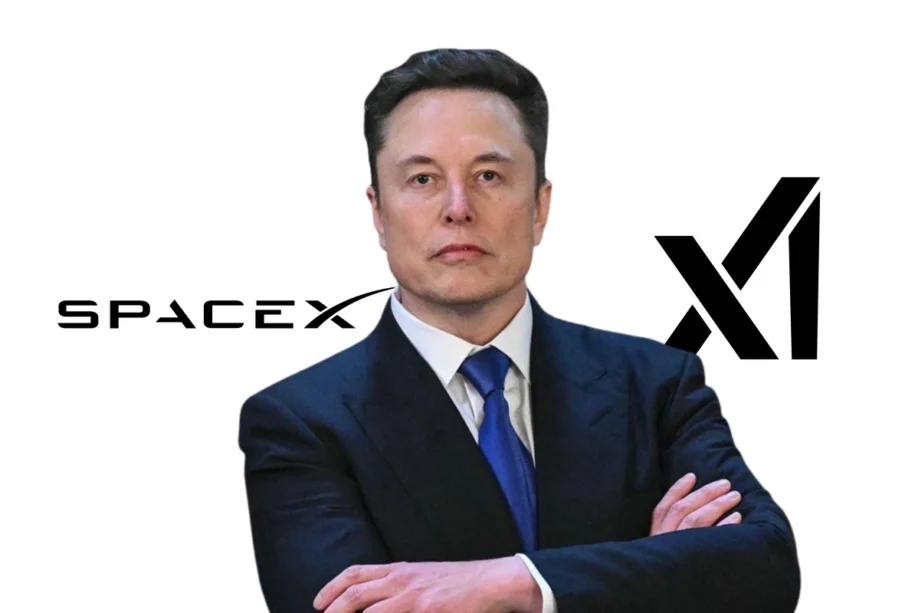
Elon Musk has officially merged his artificial intelligence company xAI with SpaceX, creating a combined entity valued at an unprecedented $1.25 trillion. This deal has set a new global record as the largest merger and acquisition in history and marks a major restructuring of Musk’s expanding business empire.
According to reports, the transaction values SpaceX at $1 trillion and xAI at $250 billion. As part of the agreement, xAI investors will receive 0.1433 shares of SpaceX for every xAI share they hold. With this move, Musk brings together rockets, satellite internet via Starlink, social media platform X, and advanced artificial intelligence systems like Grok under one vertically integrated structure.
A key question surrounding the deal is why Musk chose to merge xAI with SpaceX instead of Tesla. Industry observers note that the decision is closely linked to Musk’s long-term vision for artificial intelligence. He believes that the next phase of AI development will demand enormous amounts of energy and cooling, which traditional, Earth-based data centres may not be able to provide sustainably. Musk has repeatedly argued that space-based data centres, powered by solar energy and cooled naturally by the extreme cold of space, could be the only viable solution for scaling advanced, sentient-level AI.
In a recent internal memo, Musk stated that global electricity demand driven by AI growth cannot be met by terrestrial solutions without causing environmental and social strain. By pairing xAI with SpaceX, he aims to directly integrate AI into space technology while also using space as the physical platform to support AI’s future infrastructure. This strategic alignment makes SpaceX a more natural fit than Tesla, which remains primarily focused on automotive and energy products.
The merger also allows SpaceX to immediately benefit from AI-driven advances in engineering, navigation, and mission planning, further strengthening its technological edge. At the same time, xAI gains access to SpaceX’s launch capabilities and satellite networks, opening the door to Musk’s ambitious idea of space-based computing.
Timing is another crucial factor. The consolidation comes as SpaceX prepares for a potential initial public offering later this year. By absorbing xAI ahead of the IPO, SpaceX positions itself not just as a space and satellite company, but as a major AI player, potentially pushing its valuation beyond $1.5 trillion once it goes public.
Musk has framed the merger in philosophical terms, describing it as a step toward expanding human consciousness beyond Earth. He has said the long-term goal is to build self-sustaining bases on the Moon, establish a civilisation on Mars, and ultimately extend intelligent life deeper into the universe.
Despite its scale and ambition, the deal is expected to face close regulatory scrutiny. Given SpaceX’s extensive contracts with NASA and the US Department of Defence, government agencies are likely to review the merger carefully for governance, valuation concerns, and national security implications. Even so, the consolidation marks a bold new chapter in Musk’s vision of combining AI, space exploration, and human expansion into a single, far-reaching mission.
Recent Random Post: