








In a significant move highlighting the global potential of “India-first” innovations, Google has announced the expansion of its foundational AI models for agriculture to the wider Asia-Pacific region. The Agricultural Landscape Understanding (ALU) and Agricultural Monitoring and Event Detection (AMED) APIs, which have already empowered startups and government bodies in India, are now being made available to trusted testers in Malaysia, Indonesia, Vietnam, and Japan.
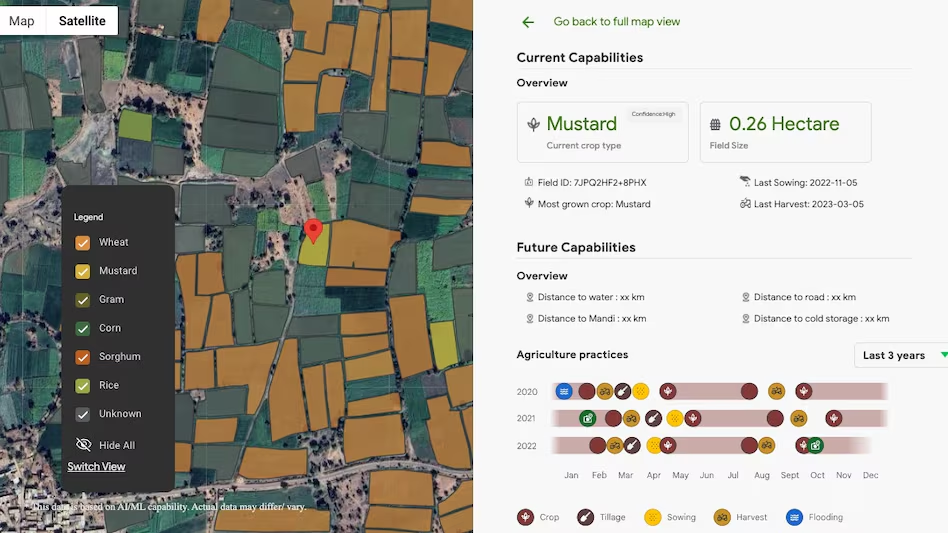
These AI-driven models leverage remote sensing and machine learning to provide hyperlocal insights, addressing critical challenges in agriculture. Unlike traditional high-level data aggregation at district or block levels, ALU and AMED deliver field-level intelligence, enabling precise, data-driven interventions.
ALU segments agricultural landscapes using satellite imagery, identifying individual fields, water bodies, and vegetation. AMED builds on this, tracking crop types, acreage, and key events like sowing and harvesting, with data refreshed every 15 days for near real-time monitoring. Together, these models unlock a previously unavailable dataset, allowing policymakers, AgriTech companies, and financial institutions to make informed decisions.
The models are powered by Google’s decades-long investment in geospatial technologies like Google Maps. While accuracy varies regionally, Google employs a multi-pronged validation strategy, combining machine learning checks, government data comparisons, and independent third-party verification.
Real-world applications are already transforming agriculture in India. From improving crop yield advisory services to enabling low-cost verification for agricultural loans, these models are reshaping the ecosystem. Partners include the Krishi DSS national platform, the Government of Telangana’s AdEx platform, and CEEW, which uses the APIs to design climate-friendly crop incentives.
With this expansion to the APAC region, Google envisions a scalable, ecosystem-led approach to agriculture. “Solutions that address India’s most pressing challenges can also solve for the world,” said Alok Talekar, Lead for Agriculture and Sustainability Research at Google DeepMind. Importantly, the data is purely geospatial with no PII, ensuring farmer privacy.
Google’s initiative exemplifies how AI and data-driven insights can empower farmers, optimize agricultural practices, and enhance financial access, while demonstrating the global scalability of innovations born in India.
Recent Random Post: