








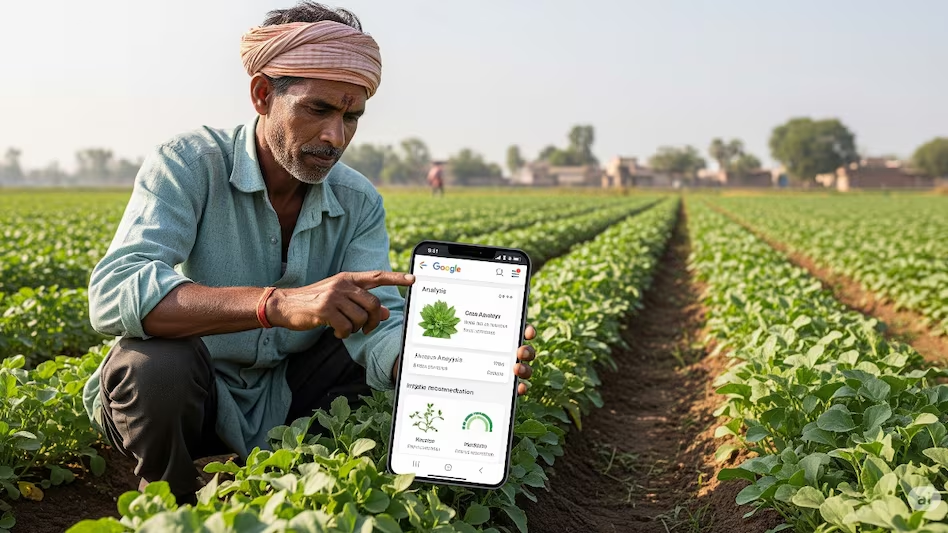
Google has announced a suite of open-source artificial intelligence (AI) tools aimed at transforming India’s agricultural sector and enriching cultural and linguistic diversity in global AI models. The initiative includes the launch of the Agricultural Monitoring and Event Detection (AMED) API and a strategic collaboration with the Indian Institute of Technology (IIT) Kharagpur under the company’s Amplify Initiative.
Developed by Google DeepMind in partnership with Google’s Partnerships Innovation team, the AMED API builds upon the earlier Agricultural Landscape Understanding (ALU) API. It integrates satellite imagery, crop labels, and machine learning to provide granular, real-time insights into field activity—including crop types, sowing and harvesting schedules, and land usage over the past three years. Updated fortnightly, the API is designed to empower agri-tech developers, researchers, and policymakers with data-driven tools to improve productivity and climate resilience in farming.
Alok Talekar, Agriculture and Sustainability Research Lead at Google DeepMind, stated that the API will support more effective agricultural interventions by offering precise, real-time information. Startups like TerraStack, incubated at IIT Bombay, are already utilizing Google’s APIs to develop rural land intelligence systems for applications such as climate risk analysis and rural credit assessment.
In parallel, Google is working with IIT Kharagpur through the Amplify Initiative to promote the development of high-quality, hyperlocal datasets in Indian languages. These datasets will be openly available to foster more inclusive and culturally relevant AI systems. The collaboration marks a significant step in building AI that reflects the rich linguistic and cultural fabric of India. The effort is informed by a community-centric and expert-reviewed approach to ensure accuracy and minimize bias.
Dr. Mainack Mandal of IIT Kharagpur described the collaboration as a pivotal moment in global AI development, emphasizing the importance of building systems that resonate with India’s diversity.
This initiative complements Project Vaani, which recently reached a key milestone by contributing over 21,000 hours of Indic language speech audio and 800 hours of transcriptions. The data, sourced from more than 112,000 speakers across 120 districts, is now accessible via India’s Bhashini platform and Hugging Face.
Dr. Partha Talukdar, Language Research Lead at Google DeepMind, reiterated the company’s commitment to creating AI experiences that are natural and intuitive for users across diverse linguistic and cultural contexts.
Google also highlighted the broader impact of its AI research, including applications in maternal health, clinical efficiency, and scientific innovation. The AlphaFold Protein Structure Database, developed by Google DeepMind, is currently being used by over 150,000 researchers in India to accelerate studies on diseases such as cancer and autoimmune disorders.
These new tools and partnerships underscore Google’s ongoing investment in AI for social good, with a particular focus on making technological advancements more accessible and impactful for India’s unique ecosystem.
Recent Random Post: