









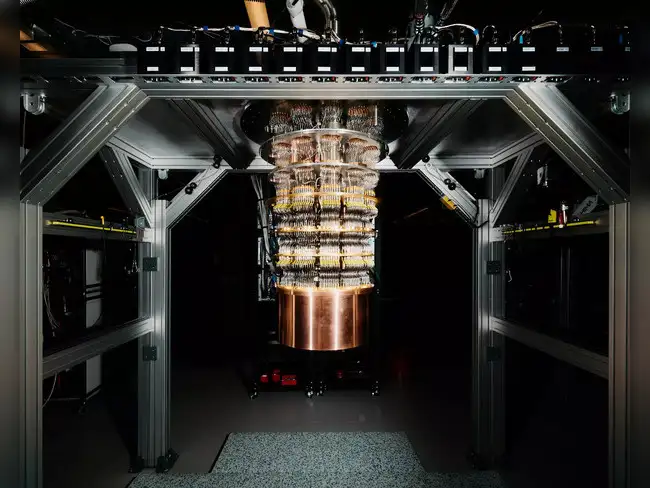
 Google, Willow Quantum Processor, Quantum Computing, Quantum Advantage, Quantum Echoes, Michel H Devoret, Sundar Pichai, Google AI, Quantum Algorithm, Nature Journal, Scientific Breakthrough, Quantum Mechanics, Qubits, Artificial Intelligence, Drug Discovery, Advanced Materials, Nuclear Magnetic Resonance, Quantum Verification, Technology News, Innovation, Future ComputingIn a historic leap for computing, tech giant Google has announced that its Willow quantum processor has achieved the world’s first verifiable quantum advantage. The breakthrough, published in the journal Nature, marks a major step toward making quantum computing practical for real-world scientific and industrial use.
Led by Nobel Prize-winning physicist Michel H. Devoret and his team at Google’s Quantum AI Lab in Santa Barbara, the researchers demonstrated that their quantum computer successfully executed a groundbreaking new algorithm known as Quantum Echoes. This development could dramatically accelerate discoveries in drug development, advanced materials, chemistry, and physics.
According to Google, “Quantum Echoes can be useful in learning the structure of systems in nature — from molecules to magnets to black holes — and we’ve demonstrated it runs 13,000 times faster on Willow than the best classical algorithm on one of the world’s fastest supercomputers.”
Understanding Quantum Computing
Traditional computers process information in bits, which take on a value of either 0 or 1. Quantum computers, however, use quantum bits (qubits), which can represent both 0 and 1 simultaneously — a property derived from quantum mechanics, the physics governing the subatomic world.
This allows quantum systems to perform complex calculations at speeds that grow exponentially with each added qubit, surpassing the limits of classical computation.
From Theory to Verifiable Reality
Google previously demonstrated quantum supremacy in 2024 when its quantum computer solved a complex mathematical problem in under five minutes — a task that would take classical supercomputers 10 septillion years. However, that result lacked practical verification or real-world relevance.
With Quantum Echoes, the difference lies in verifiability. For the first time, the outcome of a quantum computation can be independently confirmed and repeated — a crucial step toward trustworthy and scalable quantum applications.
“Quantum verifiability means the result can be repeated on our quantum computer — or any other of the same caliber — to get the same answer,” Google explained. “This repeatable, beyond-classical computation is the foundation for scalable verification, bringing quantum computers closer to practical use.”
Google CEO Sundar Pichai described the milestone as “a major step toward making quantum computing a real tool for scientific and industrial problem-solving.”
Expanding Scientific Horizons
Beyond theoretical progress, Google’s researchers have also demonstrated how Quantum Echoes could enhance nuclear magnetic resonance (NMR) — a key technique used in analyzing molecular structures and interactions.
In a companion paper on arXiv, the team outlined potential applications in chemistry, biology, and materials science, with implications for biotechnology, renewable energy, and nuclear fusion.
Moreover, Google engineers believe the same algorithm could help advance artificial intelligence by generating entirely new, high-quality datasets in fields such as life sciences, where data scarcity remains a challenge.
Toward Practical Quantum Computing
The achievement of verifiable quantum advantage with Willow represents a turning point — moving from theoretical benchmarks to usable quantum computation. As research deepens and algorithms mature, experts believe the technology could unlock breakthroughs once thought to be beyond human reach.
Recent Random Post: