








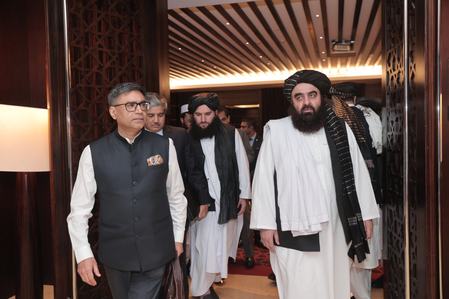
India and Afghanistan continue to strengthen their historic friendship despite the challenges posed by the current geopolitical environment, which has impacted trade flows — particularly affecting Delhi’s Khari Baoli, Asia’s largest dry fruit and spice market, due to reduced imports from Kabul.
A recent phone call between India’s External Affairs Minister S. Jaishankar and Afghanistan’s Acting Foreign Minister Amir Khan Muttaqi sent a strong message that, although the Indian government has not officially recognized the Taliban regime, New Delhi remains a trusted and reliable partner for Kabul.
The “good conversation,” during which Muttaqi condemned the April 22 Pahalgam terrorist attack and dismissed efforts to sow distrust between India and Afghanistan, is likely to unsettle Pakistan’s political and military leadership across the Durand Line. Jaishankar highlighted this on X, stating: “Welcomed his (Muttaqi) firm rejection of recent attempts to create distrust through false reports. Underlined our traditional friendship with the Afghan people and continuing support for their development needs. Discussed ways to advance cooperation.”
Hafiz Zia Ahmad, Director of Public Communication at the Islamic Emirate of Afghanistan’s Ministry of Foreign Affairs, told IANS that the discussion focused on enhancing bilateral relations, promoting trade, and strengthening diplomatic ties. Issues like facilitating visas for traders and patients, and the release of Afghan prisoners in India, were also addressed.
Last week, Afghanistan had strongly rejected Pakistan’s claims that India launched missile strikes on Afghan soil during Operation Sindoor, calling the allegations “baseless” and “unfounded.” This stance was echoed by Indian Foreign Secretary Vikram Misri, who dismissed Pakistan’s accusations as “ludicrous.”
Kabul has also expressed deep concern over rising regional tensions following the deadly Pahalgam terrorist attack, which claimed 26 innocent lives.
Many experts in Pakistan had anticipated that India’s engagement with Afghanistan would diminish following the Taliban takeover in 2021. However, contrary to these expectations, India has continued its strong involvement in Afghan humanitarian and developmental efforts under Prime Minister Narendra Modi’s government.
Notably, former ISI Director General Lt Gen Faiz Hameed’s visit to Kabul in September 2021 was touted by Pakistan as a symbolic gesture, yet within four years, Hameed has been detained, and India remains a key stakeholder in Afghanistan.
India’s approach to Afghanistan is rooted in its historic and civilizational ties, as well as relevant UN resolutions, including UNSCR 2593. Since the Taliban takeover, India evacuated its embassy personnel but has maintained a technical team since June 2022 to oversee humanitarian assistance and other matters. Jaishankar affirmed India’s non-recognition of the Taliban in line with the international community but emphasized India’s ongoing commitment to Afghan development.
The strengthening ties are the result of persistent diplomacy, with MEA Joint Secretary J.P. Singh visiting Kabul as the Taliban showed willingness to engage with India rather than Pakistan proxies. In January 2025, Indian Foreign Secretary Vikram Misri met Muttaqi in Dubai, reaffirming India’s condemnation of Pakistan’s December 24 airstrikes on Afghanistan and pledging further humanitarian aid.
The two sides also discussed greater use of the Chabahar port in Iran to facilitate trade and humanitarian supplies to Afghanistan. Afghanistan underscored its sensitivity to India’s security concerns, agreeing to maintain regular contact.
Experts believe that while mutual trust will take time to build, the evolving regional dynamics — including India-Pakistan tensions and Taliban-China engagement — have accelerated New Delhi’s efforts to deepen its relationship with Kabul.
Prof. Gulshan Sachdeva of JNU and the Daskshin Global South Centre of Excellence observed, “India’s engagement with the Taliban is driven by strategic realities and the Taliban’s desire for normalized relations. India represents a vital market for Afghan products and offers substantial development assistance. Afghan citizens eagerly await stronger ties with India, especially for medical and educational support.”
Recent Random Post: