








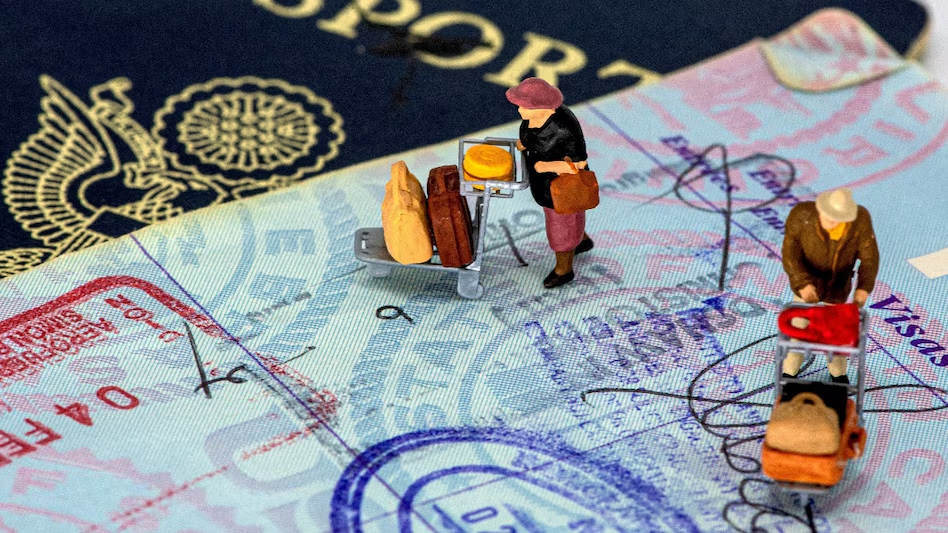
As India and the European Union enter a renewed phase of engagement following progress on a long-pending trade agreement, both sides are also signalling intent to ease one of the most persistent friction points for Indian travellers: the Schengen visa process.
The Joint India-EU Comprehensive Strategic Agenda, endorsed at the 16th India-EU Summit in New Delhi on January 27, 2026, lays out a roadmap to deepen cooperation across prosperity, sustainability, technology, security, connectivity and global governance. Within this wide-ranging framework, mobility and travel facilitation have emerged as a notable focus area.
Schengen visa procedures flagged for modernisation
The joint statement explicitly calls on both sides to “further modernise and simplify Schengen visa procedures through the upcoming digitalisation of visa procedures, once it enters into operation, while jointly addressing the challenges of visa fraud and document verification.”
For Indian tourists, students and business travellers, the language signals a possible easing of long-standing procedural bottlenecks as the EU prepares to roll out its digital visa systems. While no firm timelines have been announced, the inclusion of visa reform in the strategic agenda elevates mobility from a routine consular issue to a partnership-level priority.
Digitalisation, coupled with tighter checks
The proposed simplification is closely linked to enhanced safeguards. Alongside digital processing, India and the EU plan closer cooperation on visa fraud prevention and document verification, indicating that faster and more convenient procedures will be balanced with stricter scrutiny.
The emphasis suggests a calibrated approach—streamlining applications while reinforcing security standards—rather than a blanket relaxation of visa norms.
Context of tighter EU visa controls
The mobility discussion comes against the backdrop of stricter EU visa governance measures approved in November 2025. Under revised rules linked to the ETIAS framework, the European Union can now suspend visa-free travel for non-EU countries more swiftly if risk indicators rise.
Notably, the threshold for triggering a review has been lowered. A 30% increase in irregular migration indicators, such as asylum applications or overstays, can now prompt action—down from the earlier 50% benchmark—making it easier for the European Commission to reassess visa-free arrangements.
Mobility as part of the strategic partnership
Against this more security-conscious backdrop, the explicit reference to Schengen modernisation in the India-EU agenda suggests that both sides see smoother mobility as essential to trade, investment, education and people-to-people ties. While operational details remain pending, the political signalling points to travel facilitation being woven into the broader architecture of India-EU cooperation.
Recent Random Post: