








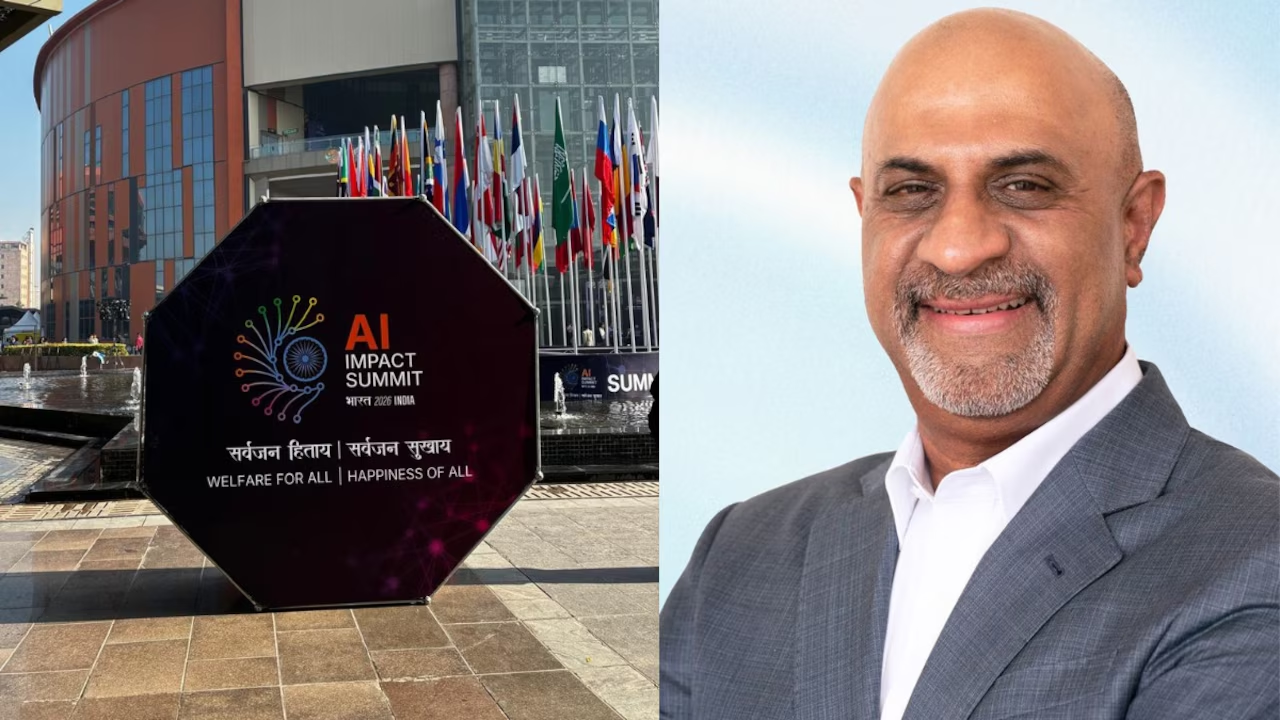
At the India AI Impact Summit 2026, Raj Koneru, Founder and CEO of Kore.ai, said India’s ambition to emerge as a global “agentic force” in artificial intelligence will depend less on adopting AI tools and more on building them. He emphasised that this transition will require a fundamental overhaul of the country’s education and skills ecosystem.
Speaking to Business Today, Koneru observed that most people currently use AI passively rather than creatively. “Most people use it as a consumer, not as a creator. So the education level and enablement are programs that need to be more adopted — not only at the professional level, but all the way from schools,” he said. He stressed that AI literacy in India remains inadequate for the scale of transformation required and called for large-scale initiatives to train engineers, doctors, and other professionals. According to him, artificial intelligence should be embedded into mainstream education as a foundational discipline, much like mathematics or science. “Everybody needs to know not just how to consume AI, but how to create with AI,” he added.
Addressing concerns about job losses, particularly in entry-level IT roles, Koneru said automation will reshape coding jobs rather than eliminate them. A significant portion of traditional coding may be automated, but the nature of work will evolve. The future skill set, he explained, will shift from writing code to defining specifications for AI systems, instructing them, and testing the outputs they generate. His remarks come amid growing debate within India’s technology sector over whether generative AI could disrupt the country’s labour-intensive outsourcing model.
Koneru also challenged the notion that India’s primary role in AI will remain limited to services. Instead, he argued that India’s real strength lies in its human capital and its ability to build applications at scale. “AI needs to be created. It doesn’t create on its own. Being able to build applications is the biggest strength of India,” he said, describing the opportunity as an “AI application mountain” rather than a traditional services market.
Founded in 2014 and headquartered in Hyderabad, Kore.ai integrates with more than 70 model providers, including systems from OpenAI, Anthropic, and Mistral AI. Koneru noted that the company does not build foundational large language models but instead focuses on orchestrating them to power enterprise workflows and autonomous agents. “We aren’t building foundational models; we are building the brains that run the enterprise,” he said.
He concluded that India’s role in the global AI landscape should go beyond service delivery to leading the development of AI-driven applications, reiterating his belief that the country can excel by transforming its vast human capital into a powerful engine for AI innovation.
Recent Random Post: