








India is poised to achieve a historic milestone in its space journey as Group Captain Shubhanshu Shukla of the Indian Air Force is set to fly to the International Space Station (ISS) next month. The mission, scheduled for May 2025, will be part of Axiom Space’s Ax-4 mission and marks the first time an Indian astronaut will travel to the ISS.
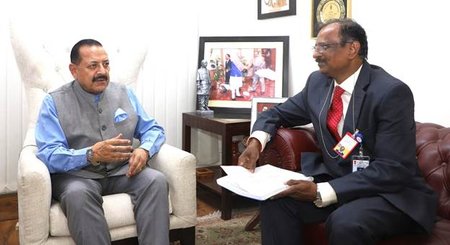
This landmark event also represents the first human spaceflight by an Indian in over four decades, following Wing Commander Rakesh Sharma’s iconic mission in 1984. The announcement was made by Dr. Jitendra Singh, Union Minister of State (Independent Charge) for Science and Technology, following a high-level review meeting with top officials from ISRO and the Department of Space.
Calling it a defining moment for India’s space ambitions, Dr. Singh said, “This mission reflects the country’s growing stature in global space collaborations and showcases India’s readiness for human spaceflight. Such missions are not just scientific achievements but are aligned with the larger vision of a self-reliant and developed India.”
Group Captain Shukla, a decorated test pilot and one of the candidates shortlisted under ISRO’s Human Spaceflight Programme, has undergone extensive training to prepare for this critical mission. His participation is expected to provide India with invaluable experience in spaceflight operations, microgravity adaptation, and astronaut safety procedures—paving the way for future missions, including ISRO’s ambitious Gaganyaan project.
ISRO Chairman Dr. V. Narayanan confirmed that Shukla is fully prepared for the mission, which emphasizes operational readiness and deepens international collaboration in space exploration.
Unlike India’s first symbolic human spaceflight in 1984, this mission is centered on building operational capability and enhancing India’s strategic presence in space. It also reinforces India’s growing partnership with global space agencies and private sector players.
The Minister also reviewed several key achievements by ISRO in 2025, including the release of solar data from the Aditya L1 mission, successful demonstration of space docking and undocking technologies, and the test firing of India’s most powerful liquid engine to date. ISRO also celebrated its 100th successful launch from Sriharikota and extended its support to national initiatives such as satellite-based monitoring for the Kumbh Mela.
India’s upcoming presence aboard the ISS is not just a moment of national pride, but a testament to its advancing capabilities and vision to become a global leader in space exploration.
Recent Random Post: