









As India’s affluent class expands at an unprecedented pace, so too does their ambition for global mobility, financial freedom, and legacy planning.
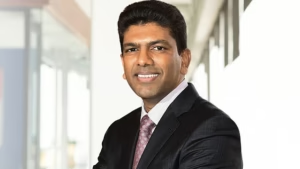
In an exclusive interview with Business Today, Andri Boiko, CEO of investment migration firm Garant In, outlines why India has become a strategic growth market for residency and citizenship-by-investment (CBI) programmes—and how the quiet rise of the “business of passports” is reshaping the aspirations of India’s high-net-worth individuals (HNIs).
“When you become wealthy, you want the freedom to live and travel without waiting on visas. That’s what we offer,” says Boiko.
A New Wave of Demand from India
Operating in India’s investment migration space for several years, Boiko observes a sharp uptick in interest from traditional hubs like Delhi, Mumbai, and Gurugram. What’s more, this trend is now increasingly driven by self-made wealth emerging from Tier 2 cities.
“They come here to work, build businesses, generate wealth—and then seek global access. That’s what this is really about,” he adds.
Wealth, Taxes, and the Legacy Imperative
For many Indian HNIs, the appeal of a second passport extends beyond travel. Tax efficiency and asset protection are critical motivators.
“If you don’t spend more than 183 days in India and have foreign income, you can significantly reduce your tax liability,” Boiko explains. “That, coupled with global mobility and the ability to create a secure legacy for their families, drives demand.”
Citizenship or residency is typically secured through government-approved investments—ranging from €250,000 to €500,000—in real estate, development funds, or business projects. Countries such as Portugal, Grenada, and Italy are among the top choices.
“Most of our clients aren’t looking to migrate permanently,” Boiko clarifies. “They want visa-free travel, access to top-tier education for their children, and long-term financial security. One-time investment, lifetime benefits.”
Europe Rising, U.S. Declining
Interestingly, the United States—once considered the gold standard of emigration—is losing favour due to its onerous global tax regime.
“We don’t recommend the U.S. for most investors,” Boiko says. “Even a green card or long stay can trigger global tax obligations if you exceed 183 days.”
Instead, structured European Golden Visa programmes—such as Italy’s “Dolce Visa”—are gaining momentum. These schemes provide residency rights without mandatory relocation or tax residency and offer a pathway to citizenship over time.
A Strategic Asset, Not an Escape Route
This marks a significant shift in mindset from earlier generations, where migration was associated with job opportunities or permanent relocation.
“Today’s Indian HNI doesn’t view a second passport as an exit plan,” Boiko explains. “It’s a strategic asset. It’s about optionality—not escape.”
Concerns around renouncing Indian citizenship are also fading, thanks to increasing awareness of the Overseas Citizen of India (OCI) framework, which provides extensive rights for those acquiring foreign citizenship.
Looking Ahead
While urban centres continue to dominate demand, Boiko notes growing interest from emerging regions.
“From Jaipur to Goa, we’re seeing clients ask the same question: How can I secure my family’s future abroad without uprooting my life at home?”
For India’s rising elite, a passport is no longer just a travel document. It’s a tool of protection, influence, and intergenerational planning—a potent symbol of modern wealth.
Recent Random Post: