








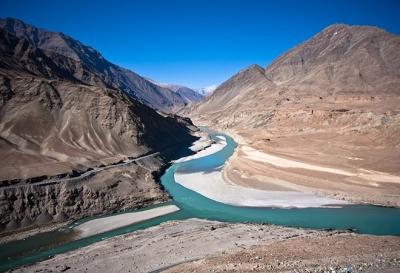
In the aftermath of the April 22 Pahalgam terror attack, India has employed a sophisticated legal strategy to challenge Pakistan’s continued support for cross-border terrorism. Central to this approach is the temporary suspension of the 1960 Indus Waters Treaty (IWT)—a move deeply embedded in principles of international law and illustrative of India’s evolving use of lawfare—the strategic use of legal norms to achieve political or security objectives.
Legal Grounds Under International Law
India’s decision draws support from customary international law and the Vienna Convention on the Law of Treaties, 1969 (VCLT). Specifically, Article 62 of the VCLT codifies the doctrine of clausula rebus sic stantibus, which permits a state to suspend or terminate a treaty when there is a fundamental and unforeseen change in circumstances that forms the basis of the treaty.
India has invoked several objective and radical changes to justify its actions:
Demographic shifts since 1960 in both India and Pakistan
Increased need for clean energy development amidst global climate challenges
Evolving assumptions underlying the treaty’s water-sharing framework
These changes meet the VCLT’s four-part threshold for invoking clausula rebus sic stantibus: the changes are objective, radical, unforeseen at the treaty’s inception, and addressed within a reasonable timeframe—evidenced by India’s prior notifications to Pakistan, including one on August 30, 2023.
Countermeasures as a Legal Justification
In parallel, India’s stance aligns with the customary international law of countermeasures, as codified in the 2001 Articles on State Responsibility by the International Law Commission. Countermeasures allow a state to adopt temporary, proportionate, and non-forcible actions against a wrongdoing state to restore legal order. By temporarily suspending the IWT, India asserts that Pakistan’s continued support for terrorism constitutes an internationally wrongful act, thus warranting lawful countermeasures.
Precedents such as the 1978 Air Service Agreements case and the 1997 Gabcikovo-Nagymaros Project case affirm a state’s right to such measures in response to treaty breaches or wrongful acts under international law.
Treaty Dispute Mechanisms in Limbo
The IWT contains a structured dispute resolution mechanism, including:
The Permanent Indus Commission
A neutral expert, as appointed by the World Bank
A Permanent Court of Arbitration (PCA) for unresolved disputes
However, the system is now in disarray. Pakistan approached the PCA prematurely, bypassing earlier stages. India, in turn, initiated a separate process with the World Bank to appoint a neutral expert. Both mechanisms have claimed jurisdiction, resulting in two parallel processes on the same issue—primarily the Kishanganga and Ratle hydroelectric projects. With the suspension of the IWT, India is now considering an exit from these proceedings, leaving the mechanisms inoperative.
Limited Recourse for Pakistan
Pakistan’s options to challenge the suspension are limited. The IWT lacks a provision for direct appeal to the International Court of Justice (ICJ). Furthermore, India’s 2019 Commonwealth reservation to ICJ jurisdiction, reaffirmed in the Aerial Incident case, restricts such proceedings between Commonwealth nations—effectively barring Pakistan from accessing the ICJ on this matter.
While Pakistan may attempt to escalate the issue at the United Nations Security Council—possibly with China’s support—India can likely rely on its allies among the permanent members to veto any adverse resolution.
Conclusion
India’s suspension of the Indus Waters Treaty reflects a deliberate and legally grounded use of lawfare to address the persistent threat of cross-border terrorism emanating from Pakistan. Grounded in established principles of international law, India’s move underscores its long-standing assertion that “blood and water cannot flow together.” It signals a shift in India’s strategic posture—one that leverages legal instruments not just defensively, but also as a proactive tool to uphold national security and political sovereignty.
Recent Random Post: