








The Indian smartphone market reached a historic milestone in 2025, driven by a strong shift toward premium devices. According to Counterpoint Research, more than one in five smartphones sold in India fell into the premium segment (priced above ₹30,000), pushing the market to its highest-ever annual value.
While total shipment volumes grew modestly by 1% year-on-year, the market’s total value surged 8%, primarily due to the expansion of the premium segment, which grew 11% YoY to capture a record 22% of overall shipments. Tarun Pathak, Research Director at Counterpoint Research, attributed this growth to stable economic conditions, strong domestic demand, controlled inflation, and reduced repo rates, which boosted discretionary spending. OEMs also strengthened their premium portfolios, emphasizing high-end camera capabilities, flagship experiences, and flexible financing options.
Apple and Vivo Lead the Market
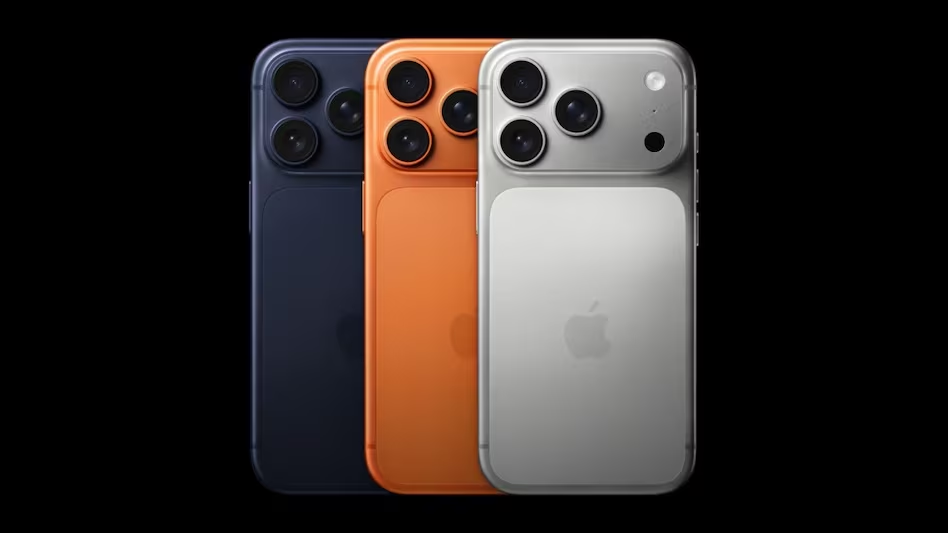
Apple emerged as the revenue leader, capturing a 28% value share—its highest ever in India. The iPhone 16 played a key role, becoming the top-shipped model in 2025 and achieving the highest-ever annual shipment share for any iPhone in the country.
In terms of volume, Vivo (excluding its sub-brand iQOO) led the market with a 20% share, followed by Samsung at 16%. Samsung dominated the foldable segment with an 88% share. Prachir Singh, Senior Research Analyst at Counterpoint, highlighted Vivo’s dual strategy across mass-market and premium segments, with the Y and T series driving volume and the X series, powered by its ZEISS partnership, surging 185% YoY.
Emerging Players and Market Trends
Smaller brands made significant gains in 2025. Motorola was the fastest-growing major brand by volume with 54% growth, while Nothing’s sub-brand CMF grew 83%. Nothing overall posted 32% YoY volume growth in Q4 2025, supported by an expanding offline retail presence and investments in local production, including a flagship store planned in Bengaluru.
The foldable segment remained led by Samsung, with Motorola trailing, while technological advancements became evident across all tiers. Average smartphone DRAM increased 5% to support AI-led applications, battery capacities rose around 9% with silicon-carbon technology, and MediaTek led chipsets with a 47% share, followed by Qualcomm at 29%.
Outlook
The market may face challenges in the budget segment due to rising component costs, potentially causing a low single-digit decline in shipment volumes. However, overall market value is expected to remain strong, with average selling prices projected to rise 5–7% as Indian consumers increasingly adopt premium smartphones.
Recent Random Post: