









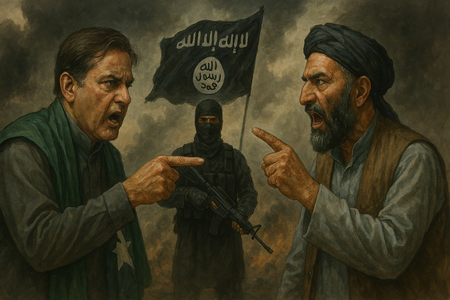
The presence of Islamic State Khorasan (ISIS-K) fighters along the volatile Durand Line between Afghanistan and Pakistan has once again raised regional and international concerns. While both Kabul and Islamabad acknowledge the threat, each continues to frame the situation in a narrative that aligns with its domestic political interests.
Recent killings of suspected ISIS-K fighters and so-called commanders on both sides of the border have intensified scrutiny of the group’s networks. The United Nations and other global security bodies have repeatedly cautioned that the porous and mountainous terrain along the Afghanistan–Pakistan frontier continues to serve as a safe haven for extremist organisations.
Tensions have escalated in recent weeks, with sporadic armed skirmishes, cross-border raids, and renewed debate over the legitimacy of the Durand Line itself. A regional initiative seeking a long-term security arrangement reportedly collapsed after both Islamabad and Kabul refused to compromise on core political and territorial positions.
Instead of moving towards a coordinated counterterrorism strategy, the two governments have shifted to isolated, localised actions while maintaining contrasting narratives. On October 29, Afghan media reported the killing in Peshawar of an ISIS-K figure identified as Nusrat—also known as Pahlawan Musa and Abu Zar—who was allegedly involved in planning attacks in Kabul during 2022 and 2023 and had led the group’s “Pahlawan” cell in Pakistan. The report, citing security sources, suggested that ISIS-K continues to maintain operational networks inside Pakistan, despite Islamabad’s consistent denial of the group’s organised presence.
Meanwhile, Pakistani authorities underscored the killing of Asim Baloch, described as a senior ISIS-K commander, in Khuzdar, Balochistan, along with a Tajik associate. Officials alleged links between ISIS-K and local Baloch militant groups, and highlighted the group’s recruitment ties to Central Asia. Afghan media, however, presented these killings as evidence that ISIS-K leadership and foreign fighters remain active and mobile within Pakistan, stressing the cross-border threat.
Reports have pointed to urban centres such as Peshawar, Karachi, and parts of Balochistan being used as transit points or operational hubs. The death of another ISIS-K figure, known as Hasan, in Karachi earlier in October, was cited by Afghan outlets to suggest deeper organisational roots in Pakistan. Hasan, originally from Peshawar, was reportedly a facilitator for operations inside Afghanistan.
The divergence in national narratives continues to complicate intelligence-sharing and coordinated operations against ISIS-K—a factor analysts describe as a serious impediment to effective counterterrorism efforts. The persistent movement of ISIS-K fighters and logistical facilitators along the border underscores an ongoing threat not only to Afghanistan and Pakistan but to the broader South and Central Asian region, including India.
Security experts warn that the alleged involvement of foreign recruits further highlights ISIS-K’s transnational ambitions and capacity to exploit regional instability.
Recent Random Post: