








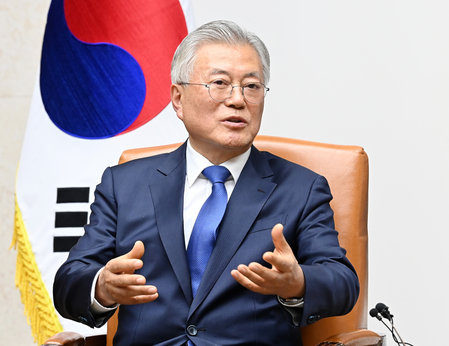
Former South Korean President Moon Jae-in has strongly criticised his indictment on bribery charges, denouncing the move as unjust and emblematic of prosecutorial overreach. Moon, who served as president from 2017 to 2022, made the comments during a meeting with National Assembly Speaker Woo Won-sik on Friday, just one day after the prosecution formally indicted him in connection with alleged preferential employment for his former son-in-law.
“The indictment itself is unjust, and it felt like prosecutors were steering the case along a predetermined path,” Moon stated. He emphasized that the charges were brought abruptly, despite his ongoing efforts to cooperate with authorities in clarifying the facts. “Prosecutors have become politicised. It seems like a clear example of how prosecutorial power is being abused,” he added.
The allegations centre on the employment of Moon’s former son-in-law, surnamed Seo, who was appointed executive director of a Thai airline in 2018. Prosecutors argue that the appointment, facilitated by the airline’s founder Lee Sang-jik—who was later named head of the Korea SMEs and Startups Agency—was made in exchange for political favours, citing Seo’s lack of industry experience.
The prosecution further alleges that Moon ceased financial support to his daughter’s family after Seo’s appointment, and that the salary and compensation paid to Seo and Moon’s daughter, Da-hye—totalling approximately 217 million won (USD 151,125)—constituted a form of bribery.
Later in the day, Moon took part in a ceremony marking the seventh anniversary of the Panmunjom Declaration, a historic inter-Korean agreement signed in April 2018 by Moon and North Korean leader Kim Jong-un. The declaration had sought to foster peace and improve relations on the Korean Peninsula, though progress stalled under Moon’s successor, former President Yoon Suk Yeol.
Moon used the occasion to criticise Yoon’s hardline stance on North Korea, particularly the dismantling of the 2018 inter-Korean military accord aimed at reducing tensions. “Resuming talks between the two Koreas is the most important. To avoid the risks of a military clash, the military agreement must first be restored,” Moon urged.
He also cautioned against growing domestic discourse on nuclear armament, labelling it a “dangerous” path that could legitimise North Korea’s nuclear ambitions, derail denuclearisation efforts, and isolate South Korea diplomatically.
Recent Random Post: