









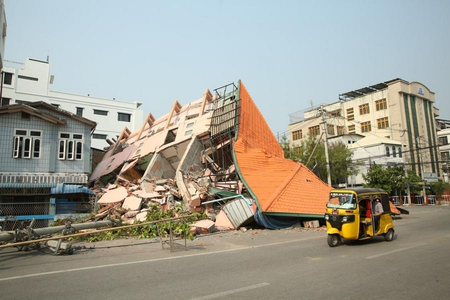
On March 29, 2025, a devastating 7.7-magnitude earthquake struck Myanmar, causing widespread destruction and significant loss of life. The earthquake, which occurred at 12:51 p.m. local time, had its epicenter near Mandalay, Myanmar’s second-largest city with a population of 1.5 million. In the aftermath, the Department of Meteorology and Hydrology of Myanmar reported a series of aftershocks, totaling 36, with magnitudes ranging from 2.8 to 7.5, continuing to affect the region as of March 31.
The earthquake has resulted in severe casualties, with approximately 1,700 people confirmed dead, 3,400 others injured, and 300 more still missing. Extensive damage has been reported across several regions, particularly in Sagaing, Mandalay, Magway, and Shan, with infrastructure such as key roads, airports, and buildings being severely impacted. Notably, the Mandalay Palace and the Mahamuni Pagoda, among other historical sites, suffered considerable structural damage.
The immediate response from the Myanmar government has been swift, with the National Disaster Management Committee declaring a state of emergency across the affected regions. Rescue operations are ongoing, with international relief efforts being mobilized to provide aid to the affected population. Emergency teams have been dispatched to support search-and-rescue efforts, deliver humanitarian assistance, and assist with evacuations.
The earthquake’s effects have been felt beyond Myanmar’s borders. In Thailand, tremors resulted in the deaths of 10 people, with 42 injured and 78 still missing, primarily in the capital of Bangkok. Several northern provinces, including Chiang Mai and Mae Hong Son, also experienced noticeable tremors, with some tourist attractions in the Pai District collapsing.
International assistance has been forthcoming, with India sending rescue teams and providing humanitarian aid to Myanmar to help with evacuation and recovery operations. The rapid deployment of support underscores the regional solidarity and the urgency of addressing the needs of those affected by the disaster.
As the region continues to grapple with the aftermath of this catastrophic event, the full extent of the damage and the scale of recovery efforts are still unfolding. This powerful earthquake, the strongest of the year to date, serves as a tragic reminder of the vulnerability of the region to seismic activity and the need for coordinated disaster response and resilience-building efforts in the face of natural disasters.
Recent Random Post: