









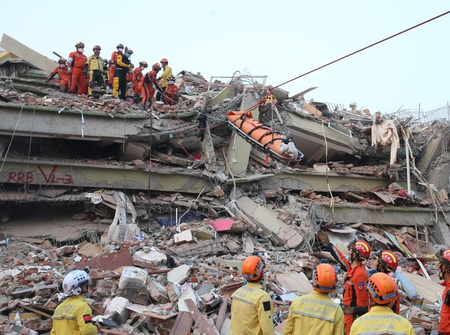
The death toll from the devastating 7.7-magnitude earthquake that struck central Myanmar on March 28 has risen to 3,770, according to state-owned daily The Mirror. The quake, one of the most powerful to hit the country in recent decades, has also left 5,106 people injured and 106 missing.The earthquake has triggered a staggering 157 aftershocks ranging in magnitude from 2.8 to 7.5, further complicating rescue and recovery operations across the affected regions.
According to Myanmar’s National Disaster Management Committee (NDMC), over 200,000 people have been displaced as a result of the quake, which caused severe destruction across 10 regions and states, including Nay Pyi Taw, Sagaing, Mandalay, Bago, Magway, and Shan.
Vice Senior General Soe Win, Chairman of the NDMC, reported at the committee’s third annual meeting that the earthquake has damaged or destroyed more than 63,000 homes, 6,700 schools, 5,400 monasteries, 5,300 pagodas, and numerous hospitals, bridges, roads, and dams.
In response to the disaster, a large-scale international relief effort is underway. A total of 2,095 rescue workers from 26 countries and regions have arrived in Myanmar, delivering over 3,800 tonnes of humanitarian aid using 147 aircraft, seven ships, and 23 vehicles. International medical teams, comprising 337 foreign healthcare personnel, have established temporary field hospitals in the worst-affected zones and are working alongside local medical teams to provide critical care.
India, under its humanitarian mission Operation Brahma, was the first nation to respond to the crisis. It has delivered more than 750 metric tonnes of relief materials, including essential medicines, food grains, ready-to-eat meals, tents, blankets, generators, mobile medical shelters, water purification systems, drinking water supplies, clothing, and prefabricated structures for emergency use.
Authorities are currently assessing structural damage using a color-coded classification system—blue, orange, and red—to prioritize and guide repair efforts. Temporary shelters, including bashas and modular units, are being constructed for displaced communities. The government has also initiated planning for long-term reconstruction, incorporating earthquake-resistant architectural designs based on soil analysis and seismic fault mapping.
The Myanmar government continues to appeal for international support as it faces the monumental task of rebuilding infrastructure and restoring normalcy in the quake-affected regions.
Recent Random Post: