Despite the trailer and songs failing to make much noise before release, Mass Jathara carried an air of curiosity — thanks to Ravi Teja’s firm assurance that the film wouldn’t let his fans down, and veteran actor Rajendra Prasad’s bold declaration that he would quit acting if the film failed to impress. With such confident claims, expectations naturally shot up. Let’s find out if their faith was justified.
Story:
Lakshman Bheri (Ravi Teja) works as a Railway Police officer in Warangal. His straightforward life takes a turn when he meets Tulasi (Sreeleela), who claims to be a government teacher but clearly hides another side of her life.
Things escalate when Lakshman thrashes a group of goons creating chaos at his railway station — unknowingly crossing paths with the local ganja mafia led by Shivudu (Naveen Chandra). Determined to clean up the city and put an end to Shivudu’s illegal network, Lakshman steps into a dangerous game of power and survival.
How a Railway Police officer takes on a monstrous drug empire forms the core of Mass Jathara.
Performances:
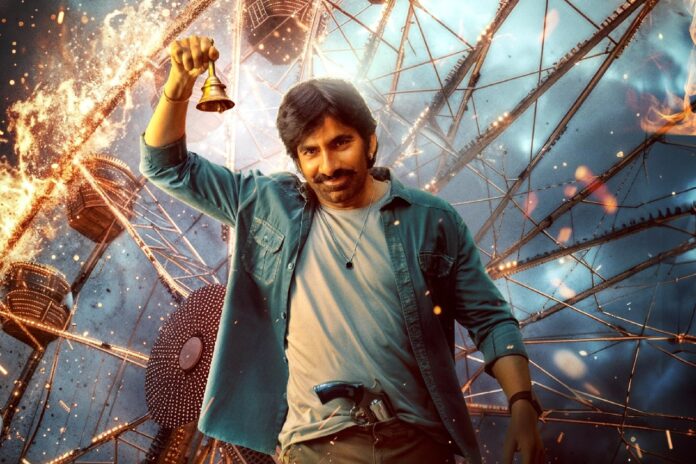
Ravi Teja once again proves why he’s called the “Mass Maharaja.” Playing a police officer is second nature to him, and he owns every frame with his infectious energy and effortless dialogue delivery. His mix of Srikakulam and Telangana slang adds authenticity, and his comic timing still lands well with the masses.
Sreeleela’s character has shades of mystery, but her role is largely limited to being the hero’s romantic distraction. Her chemistry with Ravi Teja, though formulaic, works in lighter moments.
Naveen Chandra gets a meaty role as the antagonist Shivudu and does full justice to it. He looks menacing, composed, and manages to bring gravitas to an otherwise routine villain character.
Rajendra Prasad, despite an inconsistent arc, manages to leave an impression toward the climax. The supporting cast — including Praveen, Naresh, Hyper Aadi, and TVK Ganesh — stick to their familiar zones, offering nothing unexpected.
Technical Merits:
Visually, Mass Jathara is mounted well. The cinematography lends slickness and polish, capturing the regional backdrop and action with flair. Bheems Ceciroleo’s music is high on mass appeal — the background score works better than most songs, though a few numbers suffer from weak lyrics and poor placement.
Highlights:
- Ravi Teja’s high-voltage energy
- The lizard-based fight sequence — striking and memorable
- Solid production design and crisp action
Drawbacks:
- Template-driven narration
- Flat emotional depth
- Comedy that often falls flat
- Zero novelty in storytelling
Analysis:
Telugu cinema’s mass entertainers often fall into two categories — those that blend heroism organically into a gripping story, and those that follow a checklist. Debut director Bhanu Bhogavarapu, with Mass Jathara, clearly belongs to the latter camp.
The premise — a cop taking on a smuggling syndicate — has been done countless times. The film dutifully ticks all the boxes: a powerful hero, a glamorous heroine, a brutal villain, punchy one-liners, slow-motion entries, and songs inserted at predictable intervals.
While the first half moves briskly, the narrative soon slips into familiar territory. Several sequences feel like recycled versions of Ravi Teja’s earlier hits. Editing issues are evident — with characters like Samuthirakani, Murali Sharma, and TVK Ganesh appearing briefly and vanishing without consequence. The emotional thread between Ravi Teja and Rajendra Prasad, meant to anchor the story, never fully clicks.
There are also signs of post-production trimming — possibly to avoid comparisons with recent films tackling similar smuggling themes — which leaves certain arcs incomplete.
However, Bhanu redeems himself in a few gripping action blocks, especially the unique “lizard scene,” which adds an unexpected thrill. Ravi Teja’s electric screen presence, coupled with Bheems’ pulsating background score, gives the film its energy bursts.
But despite these highs, Mass Jathara struggles to rise above its formula. It entertains in parts but lacks the emotional or narrative punch needed for a lasting impact.
Verdict:
Mass Jathara is a textbook mass entertainer — flashy, noisy, and tailor-made for Ravi Teja’s fan base. It offers bursts of adrenaline but little freshness. For those seeking a loud, energetic, and predictable commercial ride, it serves the purpose. But for others hoping for something new, the journey ends where it begins.
Bottom Line: Ravi Teja shines, but the story stays stuck in the same old formula.








JD Vance clarifies remarks on wife Usha’s faith after backlash
US Vice President JD Vance recently found himself at the center of a social media storm after comments about his wife, Usha Vance’s faith, drew mixed reactions online. Speaking at a Turning Point USA event in Mississippi, Vance mentioned that while Usha is not a Christian, she attends church with him and their children, who are being raised in the Christian faith. He also shared that his wife had played a significant role in helping him reconnect with his spirituality, adding that he hopes she might one day embrace Christianity.
However, the remarks triggered backlash on social media, with several users accusing him of being disrespectful toward his wife’s beliefs. One X (formerly Twitter) user wrote, “It’s weird to throw your wife’s religion under the bus, in public, for a moment’s acceptance by groypers.” The post has since been deleted, but it prompted Vance to issue a clarification in which he described the criticism as “disgusting” and clarified his intent behind the original statement.
In his response, Vance explained that the question about his interfaith marriage came from someone on the left, and he chose to answer honestly rather than evade it. “My Christian faith tells me the Gospel is true and good for human beings,” he said. “My wife is the most amazing blessing in my life. She encouraged me to reengage with my faith years ago. She is not a Christian and has no plans to convert, but like many interfaith couples, I hope she may one day see things as I do.”
Vance stressed that his love and respect for Usha remain unwavering, stating that he will continue to share open conversations with her about “faith, life, and everything else” because she is his partner in all aspects of life. He also condemned the backlash as an example of “anti-Christian bigotry,” asserting that sharing one’s faith or hoping loved ones adopt similar beliefs is a normal aspect of religious life.
The controversy underscores the challenges public figures face when speaking about personal and religious matters. While Vance’s remarks were intended to express his faith and family values, the incident has reignited debate about the boundaries between personal belief and public discourse in American political life.