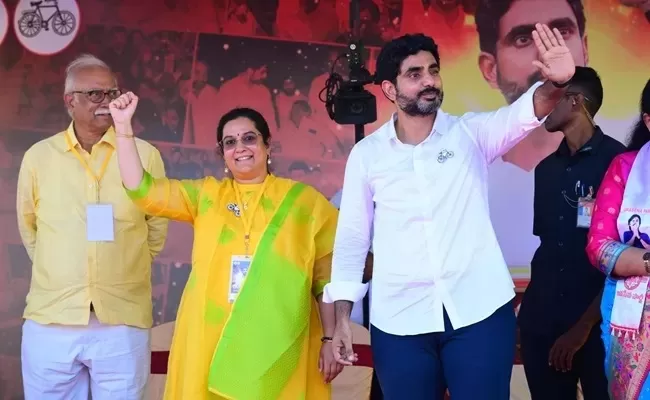









Drone Attack in Moscow: మాస్కోలో డ్రోన్ అటాక్.. భారత ఎంపీలకు తప్పిన పెను ప్రమాదం | Russia

Amala Akkineni Applauds Samantha at Zee Telugu Awards

Senior actress Amala Akkineni and Samantha Ruth Prabhu have shared a warm and respectful bond over the years, often seen together at industry events, award functions, and charity initiatives. Despite Samantha and Naga Chaitanya’s separation in 2021, the mutual regard between Amala and Samantha appears to have remained unchanged.
Their recent appearance at the Zee Telugu Awards ceremony drew widespread attention and emotional reactions from fans. The event became a topic of discussion across social media, not just for the glitz and glamour, but for the genuine warmth shared between the two women.
As Samantha celebrated 15 years in the film industry, she delivered an emotional speech, expressing gratitude to her fans for their unwavering support through both her highs and lows. What followed next truly touched the hearts of many — Amala Akkineni, seated among the audience, responded with a proud and supportive applause, visibly moved by Samantha’s words.
This small yet significant gesture didn’t go unnoticed. In a promotional clip from the awards ceremony, viewers saw Amala acknowledging Samantha’s heartfelt speech with admiration, sparking a wave of reactions online. Fans praised the dignity and grace both women displayed. One user emotionally noted, “Did you see Amala’s gesture of appreciation? It was beautiful.”
Though Samantha and Naga Chaitanya ended their four-year marriage in 2021, moments like these remind everyone that mutual respect and affection can endure beyond personal changes. The bond between Amala and Samantha, as showcased on this emotional night, continues to be cherished by fans.
Kamal Haasan Claims Thug Life Will Surpass Nayagan

Kamal Haasan is currently immersed in the promotions of his upcoming film Thug Life, directed by the legendary Mani Ratnam. The film marks a monumental reunion between the two icons of Indian cinema after nearly 38 years — their last collaboration being the classic Nayagan. What’s grabbing headlines, however, is Kamal’s bold statement that Thug Life will be “bigger than Nayagan,” a comment that has sparked both excitement and skepticism among fans.
Historically, Kamal Haasan has taken a nuanced and grounded approach when promoting his films. He’s known for discussing the craft, storytelling, and technical intricacies rather than indulging in hype-driven marketing. Even during the promotions of the blockbuster Vikram, Kamal focused more on the filmmaking process than exaggerating expectations.
But a noticeable shift has been observed since Indian 2. During its promotions, Kamal heavily emphasized the scale of Indian 3, even before Indian 2 had hit the screens. Critics and fans speculated that this might have been a strategy to control the narrative or create buzz, possibly due to Kamal’s own reservations about Indian 2. This shift in tone was unusual and seen by some as a move towards trend-driven marketing rather than his traditional, content-focused discourse.
Now, with Thug Life, Kamal seems to be doubling down on this approach. His assertion that it will surpass Nayagan — a film considered a masterpiece and a benchmark in Indian gangster dramas — has left audiences intrigued and apprehensive. Nayagan is not just a film; it’s a cultural milestone that continues to resonate with cinephiles and filmmakers even decades later.
Adding to the curiosity is the fact that neither Kamal Haasan nor Mani Ratnam have offered much clarity on the film’s plot or tone — a stark contrast to their usual promotional strategies. Meanwhile, Kamal has also praised Mani Ratnam’s evolution as a filmmaker, hinting at a resurgence in his creative prowess. It’s worth noting that aside from Ponniyin Selvan and OK Kanmani, most of Mani’s recent works have faced mixed reviews and underwhelming box office results, particularly in Telugu-speaking regions.
In this context, fans are torn. While many are eager to see the magic that Kamal and Mani can recreate, others are wary of the film being overhyped — a concern that stems from Kamal’s new promotional style. For many long-time admirers, Kamal is celebrated for his intellect and cinematic insight, not as a marketer chasing viral soundbites.
With the release date set for June 5, 2025, all eyes are on Thug Life. Will it live up to Kamal’s ambitious declaration? Or is this another case of inflated expectations ahead of a middling result? Time will tell.
Rukmini Vasanth in Talks for Big Films Amid ‘Dragon’ Commitment

Actress Rukmini Vasanth is currently part of one of the most-anticipated South Indian films — the Jr. NTR and Prashanth Neel project, tentatively titled Dragon. As per reports, she has signed an exclusive contract for this high-budget film, which restricts her from taking up other projects during its production. Such agreements are standard in large-scale films to avoid scheduling conflicts and ensure actors’ full availability.
Despite this exclusivity, Rukmini seems to be in high demand. Buzz in the industry suggests that she is being considered for multiple major projects. One such film is with veteran actor Venkatesh Daggubati, which is expected to be directed by ace filmmaker Trivikram Srinivas. Sources indicate that Trivikram has already narrated the script to Rukmini, hinting at serious discussions.
Adding more excitement to her growing career graph, another rumour doing the rounds is that Rukmini is also in talks for Spirit, a highly awaited film by Sandeep Reddy Vanga, starring Rebel Star Prabhas in the lead.
This raises an interesting question — will Rukmini be able to take up these prestigious projects while being contractually bound to Dragon? As of now, there is no official word from director Prashanth Neel or the producers regarding the flexibility of her contract.
Meanwhile, Jr. NTR officially joined the sets of Dragon in Karnataka on April 22, 2025. The film is scheduled for a grand release on June 25, 2026. While a special glimpse of the film was initially planned to coincide with Jr. NTR’s birthday, it was postponed to allow focus on the announcement of War 2.
All eyes are now on Rukmini Vasanth, as fans await confirmation on her next big moves in South Indian cinema.
Kiran Abbavaram & Rahasya Welcome Baby Boy

Talented young Telugu actor Kiran Abbavaram has shared a heartwarming update with his fans — he and his wife, Rahasya, have been blessed with a baby boy. Taking to social media, Kiran posted an emotional photo where he is seen lovingly kissing the tiny feet of his newborn son, capturing the pure joy of becoming a father.
This tender moment is melting hearts across social media, as fans pour in their wishes for the new parents. The picture reflects Kiran’s overwhelming happiness and the emotional depth of stepping into fatherhood for the first time — an unforgettable milestone in any man’s life.
Kiran and former actress Rahasya Gorak, known for her role in Raja Varu Rani Garu, tied the knot in a private ceremony on August 22, 2024. Less than a year later, the couple is celebrating the arrival of their bundle of joy, marking a beautiful new chapter in their journey together.
We extend our warmest congratulations to Kiran and Rahasya on this wonderful occasion. May their son be blessed with love, happiness, and a life full of health and success.
Kantara Prequel on Track for October 2 Release

Actor-writer-director Rishab Shetty stunned audiences across the globe with his National Award-winning performance in Kantara. The film, which turned into a massive pan-India blockbuster, captivated viewers with its rooted storytelling, and the hauntingly powerful music and background score by Ajaneesh Loknath only amplified Rishab’s masterful vision.
The movie has since earned a cult following, and excitement surrounding its much-anticipated prequel — tentatively titled Kantara: Chapter 1 — is at an all-time high. Recently, some reports hinted at a possible delay in the release. However, Hombale Films, the renowned production house behind the franchise, has firmly dismissed these rumors.
In an official statement, the makers confirmed that the film is progressing as per schedule and will hit the big screens on October 2, 2025. They reassured fans that the shoot is proceeding smoothly, in line with the planned timeline, and promised that more exciting updates will be shared soon.
With high expectations and a devoted fan base, Kantara: Chapter 1 is poised to be another cinematic milestone.
Publishers Sound Alarm Over Google’s AI-Powered Search Impact

Google’s recent rollout of its AI Mode in search results has raised significant concerns among global publishers and digital media outlets. Designed to deliver AI-generated summaries—known as AI Overviews—at the top of search pages, this feature aims to provide users with quick, conversational answers without requiring clicks through to original sources. However, many publishers report this innovation is severely disrupting their traffic and revenue models.
Declining Clicks, Shrinking Revenues
According to a Digiday report, prominent publishers like The Sun have experienced a dramatic 40% decline in global unique monthly users since the wider implementation of AI Overviews. Industry estimates suggest that AI summaries could drive an average 25% traffic drop across publishers, potentially translating to an annual revenue loss of up to $2 billion for the media sector. This erosion of user engagement poses an existential threat to outlets that rely heavily on search-driven advertising income.
The Erosion of Traditional SEO
For decades, publishers have depended on Search Engine Optimization (SEO) strategies to ensure content visibility and organic discovery. Google’s AI Mode, however, upends this paradigm by generating paraphrased answers in a conversational format, frequently without source attribution. As a result, websites optimized for traditional SEO risk being bypassed entirely if the AI summary suffices to answer user queries.
This fundamental shift raises the stakes for content originality and challenges the relevance of longstanding SEO practices. Publishers fear that only content designed explicitly for AI summarization will be prioritized, further marginalizing conventional content discovery methods.
Content Use Without Publisher Consent
Internal documents obtained by The Verge reveal that Google declined proposals to allow publishers fine-grained controls over how their content is incorporated into AI Overviews. The company maintains that opting out of AI summaries would require publishers to forgo Google Search altogether—a step deemed impractical by most.
In response, the News/Media Alliance, representing over 2,000 media organizations, has condemned Google’s approach as “theft.” The Alliance has called on the U.S. Department of Justice to initiate an antitrust investigation, accusing Google of using publisher content without consent to train and monetize AI technologies, all while excluding creators from compensation.
Google’s Monetization Strategy and Lack of Transparency
Despite industry pushback, Google is advancing with plans to monetize AI Mode. At Google Marketing Live 2025, the company announced it would embed advertisements within AI Overviews, including sponsored product links and localized business recommendations. These ads will be displayed regardless of whether users click through, further diverting potential revenue away from original content creators.
Compounding publisher frustration is Google’s limited transparency regarding click-through metrics for AI-generated summaries. Without detailed analytics, publishers struggle to assess the true value or impact of their inclusion in AI Overviews.
Acer Showcases AI-Driven Innovation Across Devices at Computex 2025
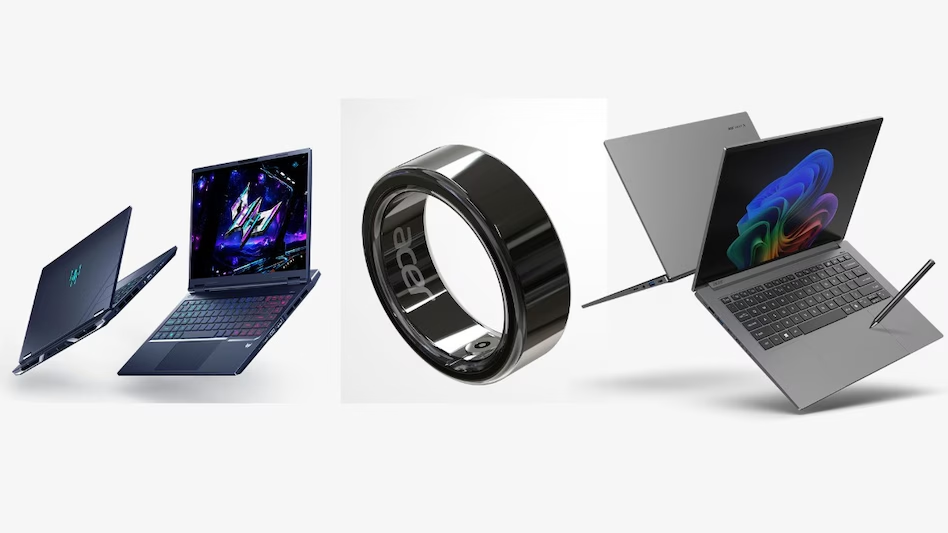
Acer Unveils AI-Centric Product Ecosystem at Computex 2025
At Computex 2025, Acer unveiled a forward-thinking portfolio of products across computing, gaming, wearables, and smart mobility—underscoring its commitment to artificial intelligence, immersive user experiences, and sustainable innovation. The showcase featured a comprehensive lineup of AI-powered Copilot+ laptops, cutting-edge gaming monitors, intelligent wearable devices, and next-generation e-mobility solutions.
AI-Enhanced Aspire Laptops Expand the Copilot+ PC Lineup
Strengthening its Copilot+ PC portfolio, Acer introduced six new Aspire AI laptops available in 14- and 16-inch variants. Engineered for students, professionals, and families, the Aspire AI series combines ultra-slim aluminum designs with robust AI capabilities and extended battery life.
Equipped with a choice of Intel Core Ultra, AMD Ryzen AI 300 Series, or Snapdragon X processors, the devices offer powerful performance with up to 32 GB LPDDR5X RAM and 1 TB PCIe Gen4 SSD storage. The high-resolution WUXGA+ OLED displays are VESA DisplayHDR TrueBlack 500 certified, ensuring superior color and contrast.
All models support advanced connectivity options, including Wi-Fi 7 and Bluetooth 5.4 (Intel and AMD models), and are fully integrated with Microsoft’s new AI experiences—Recall, Click to Do, and Enhanced Windows Search. Acer also includes proprietary AI tools for productivity enhancement, content creation, and smarter video conferencing.
Gaming and Entertainment Displays: Redefining Immersive Visuals
Acer continued to push boundaries in display technology with its latest Predator and Nitro monitor offerings:
Predator X27U F5: A 27-inch QD-OLED display delivering WQHD resolution with a groundbreaking 500Hz refresh rate.
Predator X27 X: Offers immersive 4K visuals at 240Hz, catering to high-end gamers and creators.
Both monitors support AMD FreeSync Premium Pro and feature Delta E<1 color accuracy for ultra-smooth, true-to-life visuals. The Nitro series was also expanded with smart entertainment monitors powered by Google TV: Nitro GA321QK P: A 31.5-inch 4K UHD display. Nitro GA341CUR W0: A 34-inch ultrawide QHD monitor with up to 240Hz refresh rate and rich sRGB color reproduction. For portable needs, the Acer Nitro PG271K offers 4K resolution in a compact form factor with Full HD at 144Hz and IPS technology for versatile, space-efficient setups. AI-Powered Wearables: FreeSense Ring and AI TransBuds Expanding into the wearable technology space, Acer introduced: FreeSense Ring: A lightweight titanium alloy smart ring providing 24/7 health monitoring, including heart rate, HRV, SpO₂, and sleep analysis. The data is processed through a subscription-free companion app. AI TransBuds: Advanced translation earbuds supporting real-time interpretation across 15 languages. Unique to the design, only one user needs to wear the earbuds for effective two-way communication. They also support transcription and live captioning—ideal for meetings, travel, and international collaboration. Smart Mobility Innovations: E-Scooters and E-Bikes Acer’s smart mobility division revealed a revamped range of e-scooters and e-bikes designed for modern urban transport and adventure riding: Predator Storm and Thunder eScooter Series: Featuring 400W–500W motors, app-enabled ride tracking, adaptive braking, and comprehensive safety features. Predator eRanger: A rugged fat-tire e-bike built for all terrains, offering intelligent performance controls via a mobile interface. Conclusion Acer’s Computex 2025 lineup highlights its holistic approach to innovation, blending AI, mobility, and immersive design across its product ecosystem. From Copilot+ laptops and QD-OLED gaming monitors to intelligent wearables and e-mobility solutions, Acer continues to position itself at the forefront of next-generation digital experiences. Let me know if you’d like this adapted for a press release, blog post, or presentation format.
Canada Slashes Study Permits for Indian Students Amid Policy Tightening
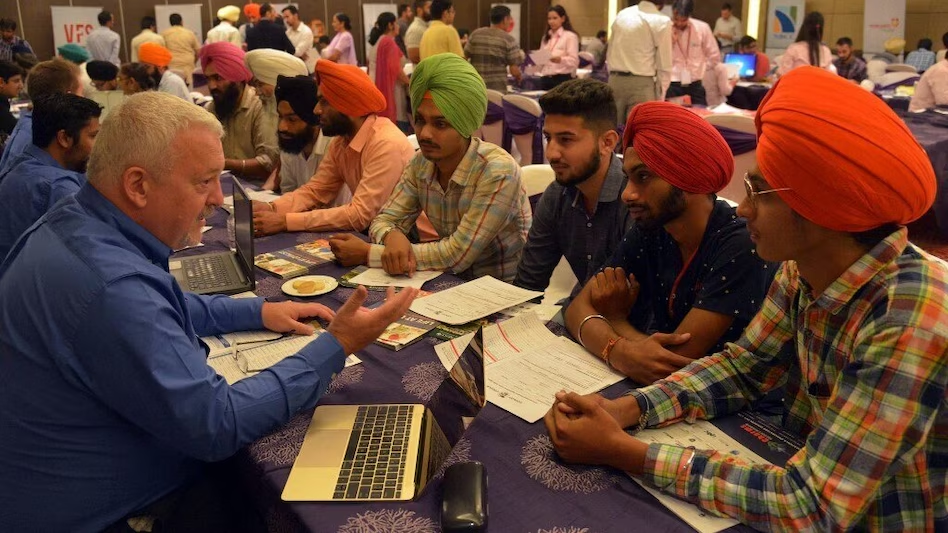
Canada has recorded a significant decline in study permit approvals for Indian students in the first quarter of 2025, marking the steepest quarterly fall in over a decade. According to Immigration, Refugees and Citizenship Canada (IRCC), only 30,640 study permits were issued to Indian nationals between January and March 2025—a 31% drop compared to 44,295 approvals during the same period in 2024. This reduction represents a fall of 13,655 permits year-on-year.
The contraction is part of a broader trend, with global study-permit issuances falling from 121,070 to 96,015 during the same period. The data suggest that Canada’s tightening of international student policies is having a pronounced impact beyond any single country.
India, which has been Canada’s top source of international students since 2018—contributing 40–45% of total annual permits—stands to see substantial implications. The sharp dip in Indian enrolments poses a revenue risk to many Canadian colleges and universities that rely heavily on international tuition, which exceeded CAD 10 billion in 2024, as estimated by the Parliamentary Budget Office.
The decline follows the Canadian government’s move in late 2023 to cap study-permit allocations, driven by concerns over housing shortages and post-secondary capacity. As of January 1, 2025, financial proof requirements have doubled from CAD 10,000 to CAD 20,635. Additionally, applicants must now submit mandatory provincial attestation letters, contributing to longer processing timelines and prompting some students to reconsider destinations such as the UK or Australia.
Education experts note that the current trend is reshaping institutional intake cycles. Several colleges have already reduced their September 2025 admission targets and are urging prospective students to begin applications at least nine months in advance, ensuring comprehensive documentation related to finances, tuition payments, and accommodation arrangements.
With IRCC indicating a further 10% cut in the national study-permit cap for 2025, the second quarter may bring continued constraints. A meaningful recovery in Indian student numbers, analysts suggest, will depend on improvements in housing infrastructure and a strategic diversification of revenue streams by educational institutions.
India Rolls Out Biometric ePassports for Secure, Seamless Travel

India has officially begun the phased rollout of its RFID-enabled ePassport, introducing a significant upgrade to the traditional passport system. This advancement places India among an elite group of over 120 nations—including the United States, Canada, France, Japan, and Australia—that have already embraced biometric passports.
Characterized by a gold-colored chip logo on the navy-blue cover, the new ePassport features an embedded electronic chip and antenna. This chip securely stores the holder’s personal and biometric data, which can be authenticated globally in seconds. The move not only strengthens document security but also expedites immigration clearance, reducing wait times and virtually eliminating the risk of forgery.
Key Features of the ePassport
1. Enhanced Data Security
All personal and biometric details are stored both in print and in a tamper-proof encrypted chip. The chip is safeguarded using Public Key Infrastructure (PKI), offering multiple layers of encryption and security.
2. ICAO Compliance
India’s ePassport adheres to the International Civil Aviation Organization’s (ICAO) Doc 9303 standards. It incorporates Basic Access Control (BAC), Passive Authentication (PA), and Extended Access Control (EAC) for fingerprint authentication—ensuring global interoperability and security.
3. Faster Border Processing
Equipped for contactless e-gates, the ePassport allows automated verification at immigration checkpoints, minimizing queues and human error.
4. Strong Fraud Deterrence
Advanced features such as micro-text, holograms, and secure encryption make counterfeiting nearly impossible, according to officials.
How to Apply for an ePassport in India: Step-by-Step Guide
Step 1: Register Online
Visit passportindia.gov.in and click “Register Now” to create your user account.
Step 2: Log In and Select Service
Choose “Apply for Fresh Passport/Re-issue of Passport.”
New applicants should select “Fresh Issuance” and ensure they have not previously held a passport.
Step 3: Fill and Submit Application
Enter accurate personal details in the online form and submit it. Save the application for the next step.
Step 4: Pay and Schedule Appointment
Navigate to “View Saved/Submitted Applications,” click “Pay and Schedule Appointment,” and select a suitable date and time at a Passport Seva Kendra (PSK), Post Office PSK (POPSK), or Regional Passport Office (RPO).
Step 5: Download Appointment Receipt
After payment, download and print the receipt containing your Application Reference Number (ARN). An SMS confirmation with appointment details will also be sent.
Step 6: Biometric Data and Document Verification
Visit the designated center on your appointment date with original documents and the printed receipt. Biometric data (photo and fingerprints) will be collected, and your documents will be verified. Upon successful verification, your ePassport will be processed and dispatched to your registered address.
A Strategic Move for National Security and Digital Governance
Beyond convenience, the ePassport is a critical tool in enhancing national security. It enables real-time synchronization with watch-lists and international databases, improving surveillance on cross-border movements. The initiative is also aligned with India’s broader digital governance strategy, aiming for paperless identity verification and efficient public services.
Do Existing Passport Holders Need to Upgrade?
No immediate action is required. Current passports will remain valid until their expiry. The ePassport is being offered as an optional upgrade, allowing citizens to transition at their own pace.
The Road Ahead
The ePassport marks a transformative step toward modernizing India’s travel infrastructure. As adoption widens across the country, it is expected to significantly enhance the global travel experience for Indian citizens while reinforcing India’s position as a forward-looking digital nation.