










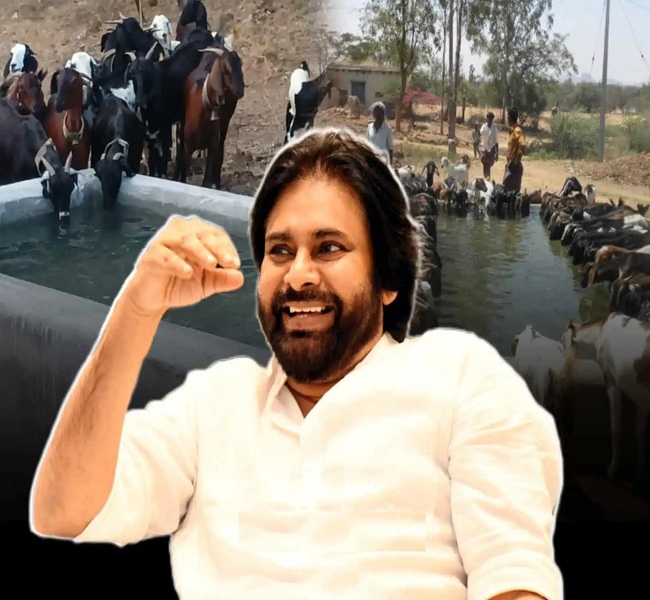
Actor and Andhra Pradesh Deputy Chief Minister Pawan Kalyan’s enduring love for animals has once again captured public admiration. Known for his deep compassion, Pawan Kalyan has previously gone viral for pictures and videos showing him caring for cows and other domestic animals at his farmhouse near Hyderabad.
Now, in the face of soaring temperatures and severe drought conditions affecting Andhra Pradesh villages, his latest initiative is earning widespread praise. Observing the dire situation of cattle and other animals struggling with acute water scarcity, Panchayati Raj Commissioner Krishna Teja proposed an innovative solution: the construction of large water bowls to provide continuous hydration to animals in rural areas.
Recognizing the urgency and significance of the proposal, Deputy Chief Minister Pawan Kalyan promptly sanctioned ₹67.50 crore for the project under the Mahatma Gandhi National Rural Employment Guarantee Act (MGNREGA). The funds have facilitated the installation of 15,000 large-capacity water bowls, each costing ₹45,000, across various villages. Two models of the bowls—with capacities of 3,500 liters and 2,300 liters—have been strategically placed and are designed to be replenished regularly, not only during summer but throughout the year.
Remarkably, the construction of these chalivendrams (water points) was completed within just 25 days from the project’s inception. Images of cows, buffaloes, sheep, goats, and other domestic animals drinking from these water bowls have since flooded social media, with many interpreting the scenes as heartfelt blessings for Pawan Kalyan.
This compassionate move has drawn praise from farmers, animal welfare advocates, and even political opponents, solidifying Pawan Kalyan’s reputation as a leader who not only envisions progressive governance but also demonstrates profound empathy for all living beings.











Trump’s Diplomatic Stance on Kashmir Conflict Draws Criticism Over Historical Missteps
Donald Trump’s recent comments regarding the ongoing tensions between India and Pakistan, particularly in light of the recent terrorist attack in Pahalgam, have generated a fair amount of debate and confusion. Known for his bold and often unfiltered statements, Trump once again drew attention with his diplomatic stance on the sensitive issue of Kashmir.
In his remarks, Trump positioned himself as being “very close” to both India and Pakistan, suggesting a neutral approach to the long-standing conflict. He stated, “I am very close to India and I’m very close to Pakistan, and they’ve had that fight for a thousand years in Kashmir.” While expressing empathy for the tragic terrorist attack, he refrained from assigning blame or picking sides, noting, “There have been tensions on that border for 1,500 years,” and suggesting that the situation would eventually resolve itself.
However, the timeline presented by Trump has raised eyebrows. His reference to a conflict lasting “a thousand years” or even “1,500 years” seems to be a historical misstep. In reality, the dispute over Kashmir between India and Pakistan only emerged after the partition of British India in 1947, making the issue less than a century old. Prior to partition, Kashmir was a princely state under British rule, and the division of India led to the creation of two separate nations—India and Pakistan—along with the subsequent territorial disputes, including the Kashmir issue.
This discrepancy in Trump’s historical perspective has not gone unnoticed by netizens, with many questioning his grasp of the region’s complex history. Some have expressed concern that his off-the-cuff remarks may reflect a lack of understanding about the specifics of the Kashmir dispute, potentially leading to misconceptions among his audience.
Despite this, Trump’s stance of maintaining neutrality between India and Pakistan aligns with his broader foreign policy approach of avoiding deep entanglements in regional conflicts. His assertion that “they’ll figure it out one way or the other” is consistent with his previous statements about leaving conflicts to the countries involved to resolve, without heavy-handed intervention from the United States.
In the context of global diplomacy, Trump’s comments serve as a reminder of the complexities of geopolitical relationships. While he has often been perceived as more aligned with India, particularly in terms of strategic partnerships, his statement highlights the delicate balance of US relations with both India and Pakistan. As tensions in Kashmir continue, it remains to be seen how the situation will unfold and whether the diplomatic efforts from both nations, with or without external influence, will lead to a lasting resolution.