








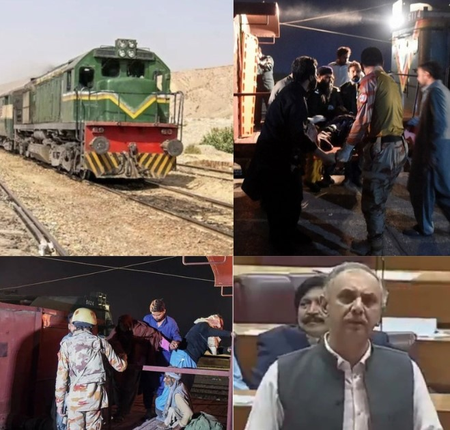
Islamabad, March 13 (IANS): The Pakistan government remained notably silent in the National Assembly on Wednesday despite mounting criticism from the Opposition regarding the handling of the Jaffar Express hijacking incident in Balochistan. The hijacking, which shook the nation, saw fierce debate in the House as Opposition leader Omar Ayub Khan lambasted the government’s response.
According to local media reports, key government ministers, including Defence Minister Khawaja Asif, Minister of State for Interior Talal Chaudhry, and Law Minister Azam Nazeer Tarar, were present during the session but refrained from issuing any policy statement on the matter. The coalition government also avoided discussing the crisis, even as tensions escalated within the Assembly.
The standoff, involving fighters of the Baloch Liberation Army’s (BLA) Majeed Brigade and the Pakistani military, ended after more than 24 hours on Wednesday evening. The military claimed a successful resolution, stating that 346 hostages were rescued while approximately 50 attackers were neutralized.
Government’s Silence Sparks Opposition Backlash
During the National Assembly session, Omar Ayub Khan demanded that regular proceedings be suspended for an urgent debate on the Jaffar Express hijacking. However, Abdul Qadir Patel of the Pakistan Peoples Party (PPP), who presided over the session in the absence of the Speaker and Deputy Speaker, dismissed the request and proceeded with the scheduled Question Hour instead.
This decision triggered a strong protest from Pakistan Tehreek-e-Insaf (PTI) lawmakers, who staged a walkout after chanting slogans against the government. Upon their return, Ayub Khan launched a scathing critique, accusing the government of apathy towards national security concerns.
“Balochistan is burning, and the government is conducting business as usual,” Khan remarked, pointing to treasury members engaged in casual discussions during the session. He questioned how dozens of heavily armed militants were able to execute such a large-scale operation in broad daylight without being detected by intelligence agencies, labeling the attack “a gross intelligence failure.”
Khan further demanded the public release of several key reports, including those of the Hamoodur Rehman Commission on the 1971 War, the Abbottabad Commission, and inquiries into the Salala checkpoint attack and the 2014 Army Public School massacre in Peshawar. He alleged that Pakistan’s 13 intelligence agencies were more focused on targeting Opposition leaders than preventing acts of terrorism.
Concerns Over Balochistan’s Security and Governance
Khan also criticized the Balochistan government for prioritizing crackdowns on political figures such as Mahmood Achakzai, Akhtar Mengal, and Mahrang Baloch while failing to curb militant activities. He claimed that 37 districts in the province had effectively become “no-go areas” due to governmental negligence.
The government’s lack of engagement on the issue was further exacerbated by the absence of key ministers during parliamentary proceedings, a matter that drew sharp rebuke not only from the Opposition but also from coalition partners.
As Pakistan grapples with increasing security challenges, the government’s reluctance to address critical issues such as the Jaffar Express hijacking raises significant concerns about its ability to ensure national security and maintain public confidence.
Recent Random Post: