









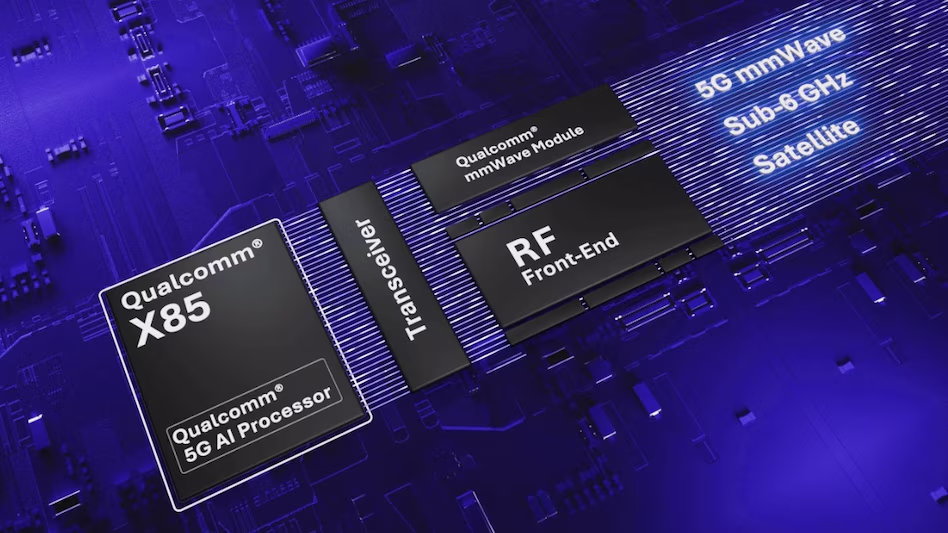
At the Mobile World Congress 2025 in Barcelona, Qualcomm unveiled its latest innovation in mobile connectivity—the Snapdragon X85 5G modem. The company’s CEO, Cristiano Amon, has positioned the X85 as a game-changing advancement, asserting that it will create a significant performance gap between premium Android devices and Apple’s iPhones.
In an interview with CNBC, Amon emphasized the modem’s AI-powered capabilities, which enhance connectivity, signal reliability, and overall user experience. Apple, which recently introduced its first in-house modem, the C1, in the iPhone 16e, remains in the early stages of developing its modem technology.
The Snapdragon X85 introduces state-of-the-art connectivity enhancements, including:
mmWave 5G support for ultra-fast speeds in high-density areas.
400MHz download bandwidth in the Sub-6GHz spectrum with 1024-QAM modulation for superior efficiency.
Satellite connectivity, ensuring seamless communication even in remote locations.
These capabilities translate into peak download speeds of up to 12.5Gbps and upload speeds reaching 3.7Gbps, making it one of the most advanced modems on the market.
However, Amon argues that AI-driven optimizations are the X85’s most defining feature. He highlighted that AI allows the modem to adapt dynamically to weaker signals, thereby extending performance range and reliability. This, he claims, will establish a notable competitive advantage for Qualcomm-powered Android devices over Apple’s iPhone lineup.
Apple’s C1 modem, debuting in the iPhone 16e, marks the company’s first major step toward modem independence following its 2019 acquisition of Intel’s modem business. Apple claims the C1 is the most power-efficient modem it has ever used, contributing to the longest battery life in a 6.1-inch iPhone and offering 25% greater power efficiency compared to previous Qualcomm modems used in iPhones.
Despite these gains, the C1 lacks mmWave 5G support, meaning users will miss out on the highest-speed connectivity available in select urban locations, stadiums, and airports. Apple has acknowledged this limitation, stating that the C1 is only the beginning and that future iterations will introduce significant improvements. Analyst Ming-Chi Kuo has reported that Apple’s iPhone 17 Air will continue using the C1 modem.
Despite its in-house modem efforts, Apple remains reliant on Qualcomm’s technology for its premium iPhone models. The company’s current agreement with Qualcomm extends through 2026, allowing Apple time to refine and improve its modem capabilities.
However, Cristiano Amon reaffirmed Qualcomm’s long-standing expectation that Apple will fully transition to in-house modems by 2027, phasing out Qualcomm as a supplier. He also underscored the growing importance of modems in AI-driven devices, stating:
“In the age of AI, modems are going to be more important than they have ever been. And I think that’s going to drive consumer preference about whether they want the best possible modem in the computer that’s in their hand all the time.”
Looking Ahead: Qualcomm’s X85 vs. Apple’s Future Modems
Qualcomm’s X85 modem is expected to launch later this year as part of the Snapdragon 8 Elite Gen 2 chipset, slated for an October 2025 release. This next-generation modem is poised to reinforce Qualcomm’s leadership in mobile connectivity.
Meanwhile, Apple’s modem technology is still in its early stages, with no clear timeline for achieving performance parity with Qualcomm. As Apple refines its in-house solutions, Qualcomm continues to push the boundaries of mobile connectivity, setting a high bar for speed, efficiency, and AI-driven enhancements in the industry.
Recent Random Post: