








A record 2.25 lakh Indians became citizens of OECD countries in 2023, the highest among all nationalities, according to the International Migration Outlook 2025 released by the Organisation for Economic Co-operation and Development (OECD). This marks the second consecutive year in which India has been the top source of new citizens across the OECD bloc.
The trend signals the growing long-term settlement of Indians in advanced economies, despite tightening visa norms — including higher H-1B fees and stricter work rules — under U.S. President Donald Trump’s administration.
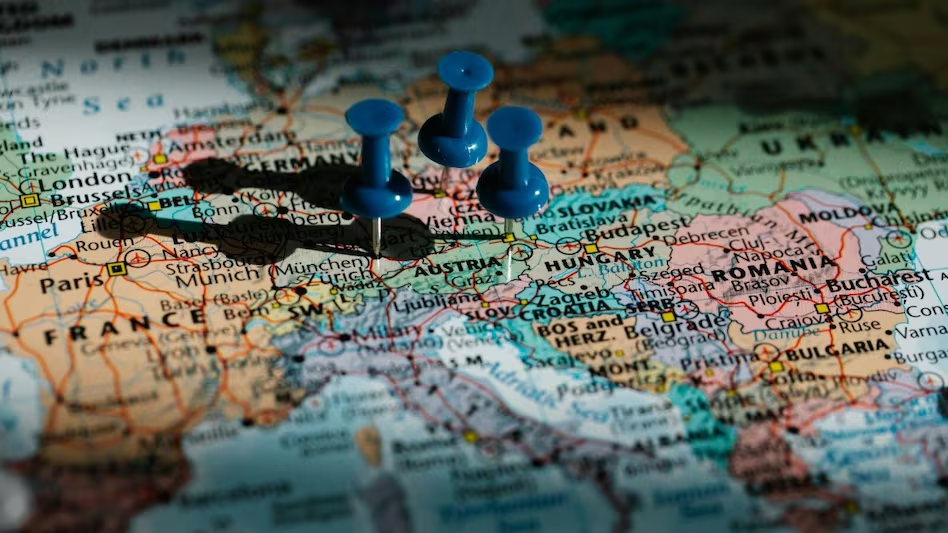
The OECD, a grouping of 38 advanced and emerging economies, includes some of the world’s most prosperous nations across North America, Europe, and the Asia-Pacific. These countries continue to attract skilled professionals, students, and entrepreneurs seeking stable opportunities in education, employment, and research.
Where Indians Are Settling Most
The sharp rise in naturalisations was led by countries such as:
United States
Canada
United Kingdom
Australia
These destinations remain top choices due to better professional prospects, higher living standards, and family settlement pathways.
For many Indian migrants, citizenship provides greater stability compared to temporary work visas. Countries like Canada and Australia offer comparatively shorter residency-to-citizenship timelines (three and four years respectively), while several European nations require stricter language proficiency, income thresholds, and cultural integration tests.
Full List of OECD Member Countries (2025)
Australia, Austria, Belgium, Canada, Chile, Colombia, Costa Rica, Czech Republic, Denmark, Estonia, Finland, France, Germany, Greece, Hungary, Iceland, Ireland, Israel, Italy, Japan, Latvia, Lithuania, Luxembourg, Mexico, Netherlands, New Zealand, Norway, Poland, Portugal, Slovakia, Slovenia, South Korea, Spain, Sweden, Switzerland, Turkey, United Kingdom, United States.
OECD’s Role in Global Migration Policy
Established in 1961, the OECD promotes economic development, global trade, and social progress. Its member states collectively account for a major share of global investment, humanitarian aid, and scientific innovation. The organisation’s analysis shows that rising naturalisation among Indians reflects both successful integration and deepening global mobility patterns.
Recent Random Post: