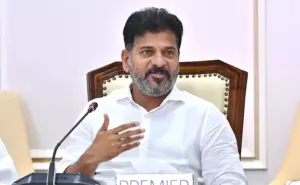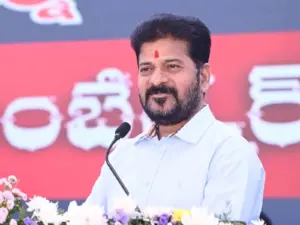




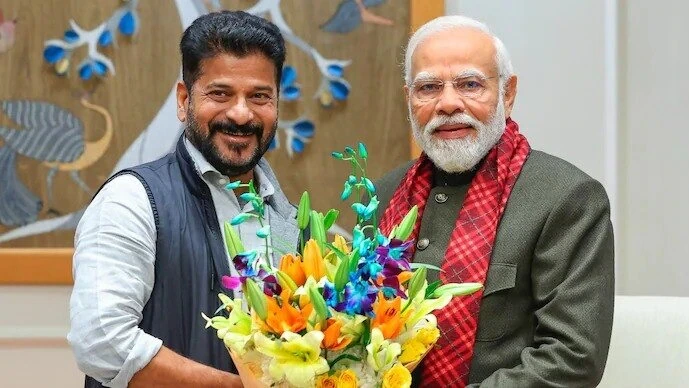
Telangana Chief Minister A. Revanth Reddy recently stirred political circles with an oblique yet pointed remark suggesting a tacit understanding between the Bharatiya Janata Party (BJP) and the Bharat Rashtra Samithi (BRS) during the recently concluded panchayat elections. In an informal interaction with the media, Revanth Reddy alleged that the two parties effectively worked together in several regions but could secure only about 33 percent of the panchayat victories, which he described as a clear reflection of their limited grassroots strength.
He further claimed that this “silent coordination” between the BJP and BRS was not coincidental but rather a calculated political experiment, potentially laying the groundwork for future alliances. “Even after contesting together, they failed to cross 33 percent. That itself exposes their real standing,” he remarked, attempting to politically corner both parties.
What has added weight to Revanth Reddy’s claims is the fact that neither the BJP nor the BRS has issued a strong rebuttal or official denial so far. Their silence has fueled speculation in political circles that the chief minister’s allegations may not be entirely unfounded.
Adding another layer to the controversy, reports from Delhi on the same day revealed that Prime Minister Narendra Modi met a group of BRS Rajya Sabha members and inquired about the health of party president and former chief minister K. Chandrashekar Rao (KCR). BRS MPs K.R. Suresh Reddy, Vaddiraju Ravichandra, and D. Damodar Rao met the Prime Minister at his office, officially stating that the discussion revolved around development-related matters. However, sources indicate that Modi personally asked them to convey his concern for KCR’s health and stressed that the message should be delivered as coming directly from him.
Political observers believe such gestures often carry deeper diplomatic or political signals. The outreach has surprised many, given KCR’s past political stance. During his tenure as chief minister, KCR was one of Prime Minister Modi’s sharpest critics, openly opposing central policies, engaging with non-BJP leaders, and even projecting himself as a potential national alternative.
Following the BRS’s defeat in the 2023 Assembly elections, KCR largely withdrew from national political activity. Notably, his daughter and senior leader Kalvakuntla Kavitha later indicated that KCR had explored the possibility of aligning with the BJP, if not an outright merger.
Speculation about a softening relationship gained momentum during the Jubilee Hills by-election, where the BJP was accused of adopting a passive strategy that indirectly benefited the BRS. Similar questions were raised when Bandi Sanjay was removed from the post of Telangana BJP president, with critics suggesting the move signaled a more accommodating approach toward KCR.
Against this backdrop, Prime Minister Modi’s renewed gesture of goodwill has raised eyebrows, particularly at a time when the BJP is seeking to strengthen its independent presence in Telangana. Political circles are now abuzz with speculation over whether the BRS is exploring entry into the NDA, whether merger talks are resurfacing, or if the BJP is attempting to politically absorb the regional party altogether.
Recent Random Post:
మద్యం మత్తులో రాజ్ తరుణ్ మాజీ ప్రియురాలు లావణ్య హల్చల్ | Lavanya
మద్యం మత్తులో రాజ్ తరుణ్ మాజీ ప్రియురాలు లావణ్య హల్చల్ | Lavanya