








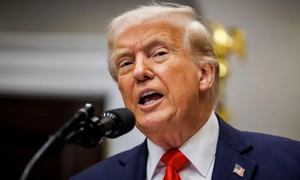
In his first 100 days in office, U.S. President Donald Trump implemented a series of executive orders and tariffs aimed at reducing the U.S. trade deficit and boosting domestic manufacturing. However, the rapid and unpredictable changes in his trade policies have left South Korean companies uncertain about making key decisions regarding overseas projects and investments.
Trump’s shifting policies, such as country-specific reciprocal tariffs of up to 50% and a 90-day implementation pause, have caused significant uncertainty in global markets, reports Yonhap. Many South Korean firms, heavily reliant on U.S. exports, are now grappling with the challenges posed by this volatile trade environment.
Trump, who began his second term on January 20, initially proposed 25% tariffs on imports from Mexico and Canada, despite their tariff-free access under the U.S.-Mexico-Canada Agreement (USMCA), but later lifted the duties. In April, he introduced reciprocal tariffs on goods from countries with trade surpluses with the U.S., along with a 10% baseline duty on imports from all countries, affecting South Korean products with a 25% reciprocal tariff.
Although some sectors, like cars, semiconductors, and pharmaceuticals, were exempt from these tariffs, they remain subject to existing or upcoming sectoral duties.
For many South Korean exporters, the lack of policy consistency from the world’s largest economy has created significant strategic challenges. To mitigate risks, some companies are exploring relocating production or scaling back operations, but experts caution that such responses have limitations. The uncertainty over future policy shifts makes long-term planning difficult and costly.
“Companies are looking to reduce costs by relocating production or adjusting shipments to the U.S.,” said Cho Seong-dae, head of the trade policy research office at the Korea International Trade Association (KITA). “But since U.S. trade policy is unpredictable, many decisions are on hold. Everyone is waiting to see what Trump will do next.”
When Trump threatened tariffs on Mexican imports, South Korean firms with manufacturing bases in Mexico, like Kia Corp., Samsung Electronics, and LG Electronics, initially planned to move production to the U.S. or increase output elsewhere. These plans were put on hold after tariffs on Mexico were waived.
Hyundai Motor Group, South Korea’s largest automaker, recently announced an investment of US$21 billion in the U.S. over the next three years to boost American production. However, the company still faces sectoral tariffs on imported vehicles.
As trade negotiations between Seoul and Washington continue, South Korea is seeking exemptions from both reciprocal and sector-specific tariffs, proposing a comprehensive “package deal” for more favorable terms. Amid these talks, many South Korean companies are taking a cautious, wait-and-see approach while preparing contingency plans.
Samsung Electronics, which spans sectors like semiconductors, home appliances, and smartphones, is confident it can navigate the shifting trade landscape thanks to its extensive global production network. Yong Seok-woo, President of Samsung’s visual display business, expressed confidence in overcoming challenges through strategic production allocation.
In the semiconductor sector, where Trump has hinted at additional tariffs, South Korean chipmakers remain on edge. “We can’t do much at this point,” said an official from a major Korean chipmaker. “We need to wait for Trump’s next announcement before we discuss our strategy.”
Recent Random Post: