








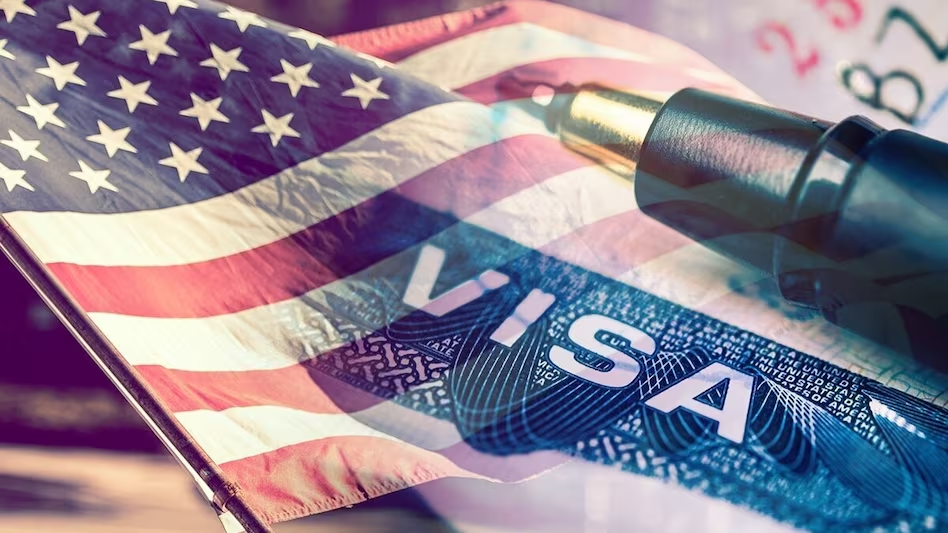
In an effort to combat widespread fraud and identity manipulation, the U.S. Department of State has proposed a rule requiring all Diversity Visa (DV) Program applicants to upload a scan of the biographic and signature page of a valid, unexpired passport at the time of entry.
Published in the Federal Register, the proposed rule aims to reduce abuse of the DV system, which annually grants up to 55,000 immigrant visas to individuals from countries with historically low rates of U.S. immigration. Under the new provision, applicants must provide their passport number, issuing country, expiration date, and upload a corresponding scanned image. Exemptions will apply only to stateless individuals, nationals of communist-controlled countries who cannot obtain a passport, or those with an approved waiver.
“Requiring passport information on the DV petition would make it much more difficult for unauthorized third parties to enter someone with partial information,” the Department stated, referencing previous cases of fraud. Notably, a scam in Ukraine involved a travel agency demanding up to $15,000 or coercing applicants into sham marriages. Similar fraudulent schemes have been reported in Bangladesh, Cambodia, and Moldova.
This new proposal echoes a 2019 rule—vacated in 2022 on procedural grounds—which led to a sharp decline in duplicate entries, from 2.5 million in FY25 to 760,079 in FY22. The State Department expects similar benefits this time, emphasizing that early passport verification would also help confirm an applicant’s country of chargeability and detect forged documents or mismatched signatures.
In alignment with Executive Order 14161 on federal digital identity standards and Executive Order 14168 on gender terminology, the Department also plans to revise regulatory language—replacing “gender” with “sex” and simplifying legal definitions.
Although the requirement may impact accessibility, especially in lower-income regions, the Department highlights the process is mobile-friendly: “Most entrants will be able to quickly scan the passport with a single photo taken by a mobile phone,” the proposal notes.
Applicants who submit incorrect passport information or falsely claim exemptions will face disqualification. The Department estimates global compliance costs at approximately $38 million, based on 25 million anticipated entries and an average processing time of 1.52 minutes per applicant. Passport acquisition costs in DV-eligible countries average $74.43.
While participation dipped during the earlier enforcement of the passport rule, regional visa quotas were still met. After the rule was vacated, participation rebounded to 23.8 million entries in FY24—but fraud incidents also surged, prompting renewed regulatory action.
The State Department is currently accepting public comments on the proposed rule, with a particular focus on passport affordability, access to scanning devices, mobile technology usage, and passport ownership rates in DV-eligible countries.
Recent Random Post: