



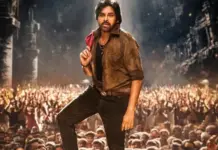




The recent theater strike has come to an end, but the core issues behind it remain largely unresolved. Amid the speculation, Pawan Kalyan has publicly suggested that the strike was a conspiracy aimed at stalling the release of his much-anticipated film Hari Hara Veeramallu. After a prolonged production cycle spanning five years—marked by political commitments and delays—the film is finally approaching its theatrical release, capturing the attention of the entire Telugu film industry.
The financial stakes are exceptionally high. Due to the extensive production costs and mounting interest burdens, the film’s theatrical revenue expectations are significant. The producer reportedly seeks around ₹60 crore from the Nizam territory alone, a figure that sets a new benchmark in the region’s pre-release business.
Nizam Distribution: A Tale of Two Camps
The Nizam distribution landscape is dominated by two major factions. On one side stands Mythri Movie Makers, while on the other is the coalition of Dil Raju, Sunil Narang, and Suresh Babu. Traditionally, film business transactions are driven by advances—exhibitors provide advances to distributors, who in turn pay producers upfront. The amount of these advances depends largely on the star power and market anticipation surrounding the film.
However, Dil Raju has taken a firm stance, declaring that no advances will be provided for Hari Hara Veeramallu in Nizam. This decision has raised eyebrows and could significantly impact the dynamics of the film’s release.
At this critical juncture, if Mythri secures the distribution rights for Hari Hara Veeramallu, it could trigger a paradigm shift in Nizam’s business equations. Exhibitors are eager for Pawan Kalyan’s film, and so far, the terms in Nizam have largely been dictated by Dil Raju and Sirish. Mythri’s entry could mean the enforcement of new terms, potentially as a form of retribution for past grievances. Moreover, given Pawan Kalyan’s strained relations with Dil Raju and associates, their approach requires caution.
Financial and Strategic Complexities
The situation is further complicated by prior financial dealings. Producer A.M. Ratnam has outstanding dues to Suresh Babu, and distributing the film through him could facilitate the recovery of these funds. This factor adds another layer of complexity to the bidding war.
Nevertheless, Mythri’s potential to acquire the rights is not guaranteed. There remains a significant gap between the ₹60 crore demanded by the producer and the practical advances distributors can realistically offer. For perspective, Salaar commanded similar business figures, while recent big releases like Devara and Gunturkaram fetched pre-release deals around ₹44-43 crore in Nizam. Star-driven projects sometimes exceed these numbers, but consistent producers typically negotiate on future adjustments in case of losses—an assurance difficult to expect from A.M. Ratnam, who is relatively unpredictable, raising the risk factor.
Marketing momentum is another unknown. The film’s songs have yet to make a significant impact, and the trailer’s release will be crucial in gauging public buzz and potential business traction.
Conclusion
As Hari Hara Veeramallu approaches its release, the battle for its Nizam distribution rights is poised to redefine market dynamics. The interplay between major distributors, financial stakes, and Pawan Kalyan’s political and industry clout will determine not only the film’s commercial fate but also potentially shift the balance of power in Telugu film distribution.
Recent Random Post:
ప్రేమ కోసం యువతి ప్రాణత్యాగం | Young Woman Ends Life Over Love || Neralu Ghoralu
ప్రేమ కోసం యువతి ప్రాణత్యాగం | Young Woman Ends Life Over Love || Neralu Ghoralu