









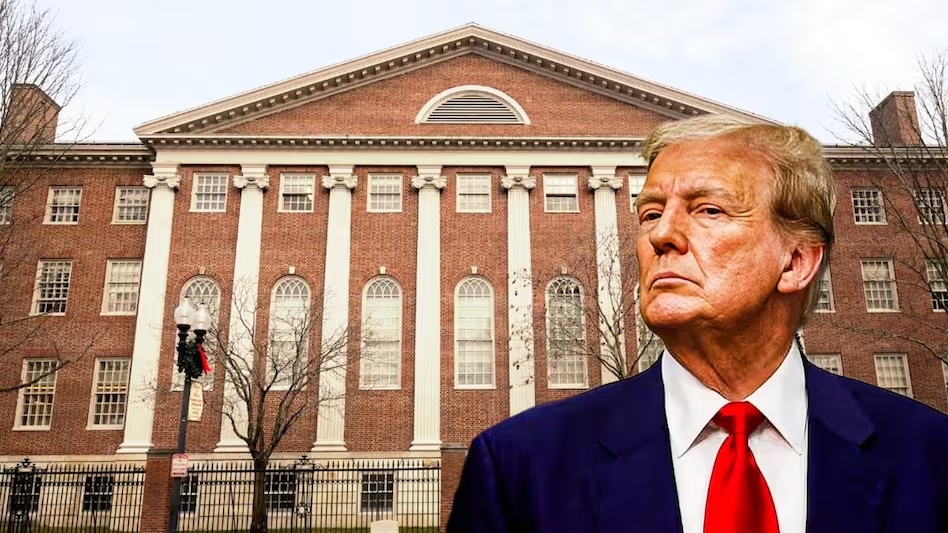
In a sweeping set of executive actions, former President Donald Trump has launched a major initiative aimed at reshaping American education policy, emphasizing transparency, academic performance, and ideological neutrality. The measures mark a significant escalation in Trump’s broader campaign to reform U.S. education ahead of the 2024 presidential election.
A central focus of the new directives is increased scrutiny of foreign funding in higher education. Colleges and universities will face tighter enforcement of longstanding federal requirements to disclose substantial foreign gifts and contracts. This move follows mounting tensions between the White House and institutions such as Harvard University, which has faced criticism over its diversity programs and recent campus protests. The U.S. Department of Education recently accused Harvard of submitting “incomplete and inaccurate” reports on foreign contributions over the past decade. Under the new order, both the Department of Education and the Department of Justice are empowered to take enforcement action, including suspension of federal funding for noncompliant institutions.
Another key directive targets accrediting agencies, which Trump accused of prioritizing diversity, equity, and inclusion (DEI) standards over measurable academic outcomes. The administration warned that agencies incorporating DEI criteria into accreditation decisions may face suspension or termination. Instead, the focus is to shift toward graduation rates, workforce readiness, and educational outcomes. Education Secretary Linda McMahon supported the directive, urging accreditors to move away from ideological benchmarks and toward data-driven assessments of institutional performance. The administration also aims to streamline the process for recognizing new accrediting bodies, which currently spans several years.
In K–12 education, a third executive order rolls back Obama-era discipline reforms that incorporated equity-based legal standards. Specifically, the new policy calls for eliminating the “disparate impact” standard—often used to challenge school disciplinary practices that disproportionately affect students of color—and replacing it with a behavior-based approach. Secretary McMahon has been directed to issue updated federal discipline guidelines within 60 days.
In a contrasting development, the Trump administration also introduced a new federal task force focused on promoting artificial intelligence education in schools, beginning as early as kindergarten. The initiative encourages public-private partnerships to advance STEM education, with a particular emphasis on supporting Historically Black Colleges and Universities (HBCUs) in the fields of technology and finance.
The White House further signaled its intent to examine nonprofit organizations that advocate for equity-driven educational policies, suggesting that federal funding for such groups could be reconsidered.
Together, these moves represent a significant ideological and structural pivot in federal education policy, reflecting the administration’s broader aim to depoliticize educational oversight and reorient it around measurable student outcomes and national security concerns.
Recent Random Post: