









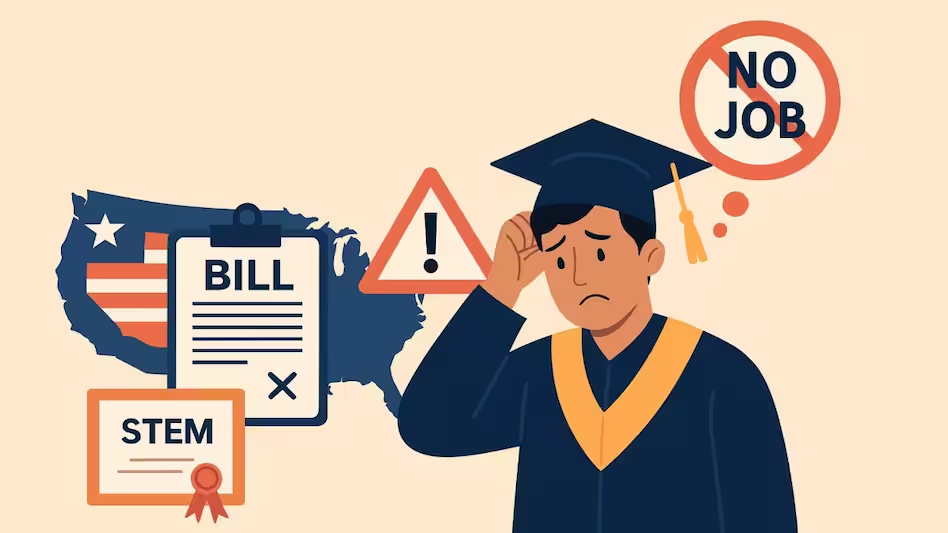
A newly introduced bill in the U.S. Congress has sparked significant concern among the international student community, particularly affecting over 300,000 Indian students currently studying in the United States. The proposed legislation seeks to eliminate the Optional Practical Training (OPT) program—a crucial post-study work authorization pathway that allows international graduates to gain practical work experience in the U.S.
OPT: A Bridge from Study to Work
Under the current system, the OPT program permits international students on F-1 visas to work in the U.S. for up to 12 months after graduation. Those with degrees in Science, Technology, Engineering, and Mathematics (STEM) fields are eligible for an additional 24-month extension, making them eligible for up to 36 months of employment. According to the Open Doors 2024 report, nearly one-third of Indian students in the 2023–24 academic year were eligible for OPT.
If the proposed bill passes, international students would be required to either immediately secure an H-1B visa—subject to strict annual caps and a lottery system—or exit the country. This abrupt shift would eliminate a critical bridge between education and employment for thousands.
Campus Uncertainty and Growing Anxiety
The bill has triggered alarm across major U.S. university campuses, including Cornell, Columbia, and Yale, which have advised international students to avoid international travel until further clarity emerges. Many students are now scrambling to explore backup options, including relocating to countries such as Canada or those in Europe with more favorable post-study work policies.
Universities have begun organizing legal briefings and forming support networks to help affected students understand their rights and navigate alternative pathways. “The panic is real, and institutions are stepping up to offer guidance and emotional support,” said Nikhil Jain, founder of ForeignAdmits.
Broader Immigration Concerns and Legislative Scrutiny
This legislative move is seen by many as part of a broader trend of tightening immigration policies, particularly under renewed efforts from the Trump-aligned bloc in Congress. Critics of the OPT program, such as Jessica M. Vaughan, Director of Policy Studies at the Center for Immigration Studies, have argued that the program lacks congressional authorization and has become vulnerable to misuse by so-called “diploma mills” issuing questionable work credentials. At a January 2025 U.S. House Judiciary Committee hearing, Vaughan described OPT and its counterpart, Curricular Practical Training (CPT), as mechanisms that “should be eliminated or much more closely regulated.”
A 2022 lawsuit filed by the Washington Alliance of Technology Workers (WashTech) further challenges the legitimacy of OPT, claiming it allows employers to circumvent the H-1B visa cap and displaces U.S. workers.
A System Without a Cap
Unlike the H-1B visa, which has a strict annual limit, the OPT and CPT programs do not operate under a numerical cap. In FY 2023, 539,382 international students participated in OPT, STEM OPT, or CPT:
276,452 students on standard OPT
122,101 on STEM OPT extensions
140,829 under CPT
These figures underscore the scale of the potential impact should the program be curtailed or eliminated.
Looking Ahead
As the bill makes its way through Congress, students, universities, and employers alike are closely monitoring developments. The outcome could have far-reaching consequences—not just for aspiring international professionals, but also for U.S. higher education institutions and tech companies that rely on global talent to maintain their competitive edge.
Recent Random Post: