









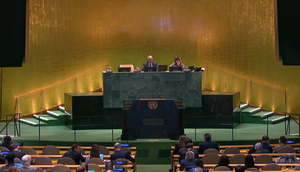
In a significant shift reflecting the evolving dynamics of its relations with Western allies, the United States successfully secured the adoption of a Security Council resolution on Ukraine without explicitly naming Russia as the aggressor. This marks the first resolution passed by the Council on the conflict since Russia’s invasion of Ukraine three years ago.
The resolution, which mourns the casualties of the “Russia-Ukraine” conflict, implores an early end to hostilities, and advocates for a lasting peace, was adopted without amendments. The success of the US-drafted resolution was facilitated by the failure of three amendments proposed by Western European nations, including France and Britain, both of which ultimately abstained from the vote.
Unlike General Assembly resolutions, Security Council resolutions are legally binding. However, the omission of direct attribution of aggression to Russia underscores a strategic shift, likely influenced by US President Donald Trump’s diplomatic efforts to negotiate an end to the war without explicitly condemning Moscow.
Diplomatic Reactions and Strategic Implications
US Charge d’Affaires Dorothy Shea emphasized the resolution’s significance, stating, “Today, we stand on the precipice of history with a solemn task—creating conditions to end the bloodiest war on the European continent since the successive cataclysms that spurred the creation of this Council. This resolution puts us on the path to peace.”
Russia’s Permanent Representative Vassily Nebenzia welcomed the move, noting that the resolution “gives us a certain optimism.” He further asserted that “militarizing Europe today is the only player internationally that wants the war to continue.”
Conversely, European allies of the US expressed dissatisfaction with the resolution’s lack of specificity. Britain’s Permanent Representative Barbara Woodward contended that, for a sustainable peace process, the Council must be explicit about the origins of the war. “There can be no equivalence between Russia and Ukraine,” she stated, explaining Britain’s decision to abstain from the vote.
Contention Over Amendments and General Assembly Dynamics
France had sought to delay the Security Council vote to allow for further diplomatic negotiations but was unable to garner enough support. Similar amendments proposed in the General Assembly, which sought to name Russia as the aggressor, had previously led to US abstention on its own resolution, marking a rare divergence between Washington and its European allies.
While the Assembly ultimately passed a resolution backed by Ukraine, the US and Russia both opposed it, further highlighting the complex diplomatic landscape surrounding the conflict.
In the Security Council, France’s proposed amendments failed to achieve the necessary votes or were vetoed by Russia. Likewise, a separate amendment proposed by Russia was unsuccessful.
The resolution was ultimately passed with ten votes in favor, while five European nations abstained. Woodward reiterated Britain’s position, stating that while the UK supports the broader goal of achieving a lasting peace, the resolution lacked clarity regarding Ukraine’s sovereignty and security needs.
Conclusion
The passage of this resolution marks a turning point in international diplomatic efforts concerning Ukraine, signaling a nuanced shift in US strategy that prioritizes peace negotiations over direct attribution of blame. However, the divergence between the US and its European allies suggests that achieving a comprehensive and unified approach to ending the conflict remains a formidable challenge.
Recent Random Post: