








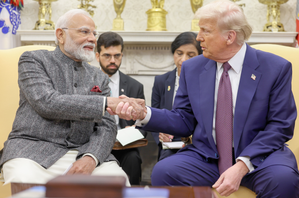
On Saturday, U.S. President Donald Trump announced a “full and immediate ceasefire” between India and Pakistan, signaling a significant diplomatic breakthrough between the two nations. The ceasefire, which was brokered by the United States, aims to de-escalate tensions that have long characterized the relationship between the two nuclear-armed neighbors.
President Trump shared the development on Truth Social, his social media platform, expressing his satisfaction with the outcome. He congratulated both India and Pakistan for “using Common Sense and Great Intelligence” to reach the agreement and thanked them for their attention to the matter. The announcement comes after intense discussions between senior officials from both countries, facilitated by U.S. mediation.
In a formal statement, U.S. Secretary of State Rubio provided further details, noting that the ceasefire was the result of 48 hours of negotiations, which involved key political and military leaders from both India and Pakistan. These included Indian Prime Minister Narendra Modi, Pakistani Prime Minister Shehbaz Sharif, Indian External Affairs Minister Subrahmanyam Jaishankar, Chief of Army Staff General Asim Munir, and National Security Advisors Ajit Doval and Asim Malik.
Secretary Rubio highlighted the constructive role played by Vice President J.D. Vance, who was actively involved in the discussions. The agreement calls for an immediate ceasefire, with both sides committing to start talks on a broad range of issues at a neutral location. This initiative marks a notable shift toward peace, with both leaders lauding the wisdom, prudence, and statesmanship demonstrated by Prime Ministers Modi and Sharif.
Additionally, Secretary Rubio expressed the importance of establishing direct communication channels between the two countries to prevent any future escalation. He offered U.S. assistance to facilitate ongoing talks aimed at preventing future conflicts. Although the U.S. role was described as offering support and facilitation, President Trump’s statement explicitly referred to the U.S. as a mediator in the process, an approach that he proposed for future conflicts as well.
State Department spokesperson Tammy Bruce clarified that Secretary Rubio’s discussions with Indian and Pakistani leaders emphasized the necessity for de-escalation and avoiding miscalculations. These talks are seen as an important first step in what could be a broader effort to stabilize relations in the region.
This breakthrough comes as a hopeful sign of diplomatic progress in a region where tensions have often led to military standoffs. The international community will closely monitor the next steps as India and Pakistan embark on this renewed path toward dialogue and peace.
Recent Random Post: