








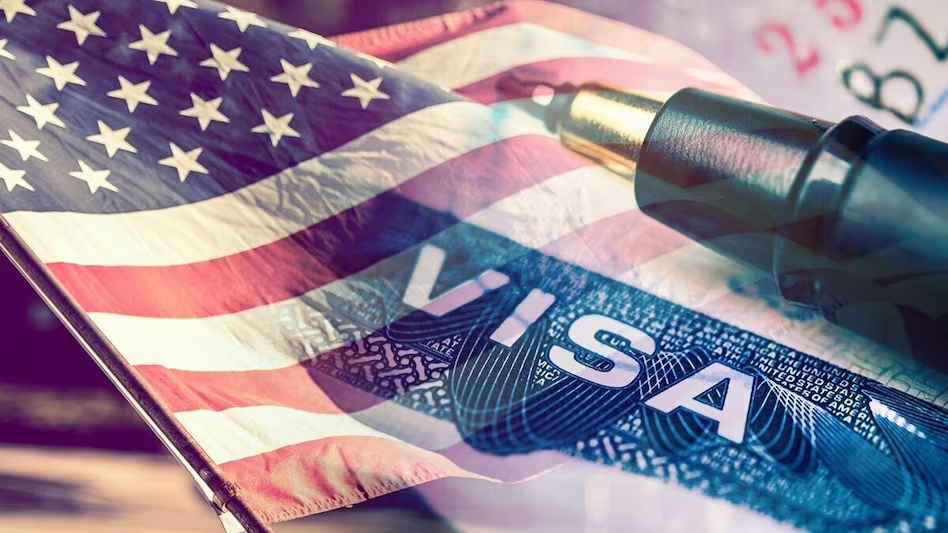
The US State Department has quietly expanded its social media screening requirements to include skilled-worker visas, widening scrutiny to H-1B professionals and their H-4 dependents from December 15. While the change was not formally announced, early applicants are already reporting interview delays, passport retention and temporary refusals under administrative processing.
Until now, mandatory social media vetting primarily applied to student and exchange visitor visas under the F, M and J categories. The expanded policy now places H-1B applicants, including those seeking renewals, under the same level of online scrutiny.
First-day impact felt at Chennai consulate
One of the earliest reports surfaced on Reddit from an applicant who attended an H-1B renewal interview at the US consulate in Chennai on December 15, the day the new screening reportedly came into effect.
The applicant said he arrived at around 8:30 am and completed the initial interview process within 30 minutes. Following standard security checks and fingerprinting, H-1B and H-4 applicants were directed to a separate queue.
“While standing there, it hit me we are probably the select few, guinea pigs, piloting the new vetting process,” he wrote. “Unfortunately, that theory held up.”
According to the post, a woman ahead of him was repeatedly asked whether all her social media profiles were set to “public.” She was subsequently issued a white 221(g) slip and informed that additional review was required.
Interview focus shifts to online activity
When the Reddit user’s interview began, the visa officer initially asked routine employment-related questions. The discussion then shifted to his online presence.
He was asked whether his social media accounts were public and whether he followed news and current events. Shortly afterward, he too received a white 221(g) slip, was informed that his application would undergo administrative processing, and had his passport retained.
Later, the Consular Electronic Application Center (CEAC) showed his visa status as “REFUSED,” a standard placeholder while cases remain under 221(g) review.
What does a 221(g) refusal mean?
A refusal under Section 221(g) of the US Immigration and Nationality Act is not a visa denial. It indicates that the consular officer requires additional information or time to complete administrative checks before making a final decision.
Applicants receive colour-coded slips — white, blue, pink or yellow — outlining next steps. A white slip, such as those issued in Chennai, typically means no immediate action is required from the applicant and that the case is under internal review.
Administrative processing can take anywhere from a few days to several months. If the issue is resolved, the visa may still be approved. However, applications not completed within one year may be closed.
In essence, a 221(g) refusal is best understood as a temporary pause rather than a final rejection.
US State Department confirms policy shift
The US State Department has since confirmed the expanded vetting approach.
“To facilitate this vetting, all applicants are instructed to adjust the privacy settings on all of their social media profiles to ‘public’,” the department said.
The move aligns with the Trump administration’s broader push to tighten visa screening and entry standards. However, officials have not provided a timeline for how long the enhanced reviews may take, leaving many skilled workers facing uncertainty around travel, employment start dates and renewals.
Recent Random Post: