









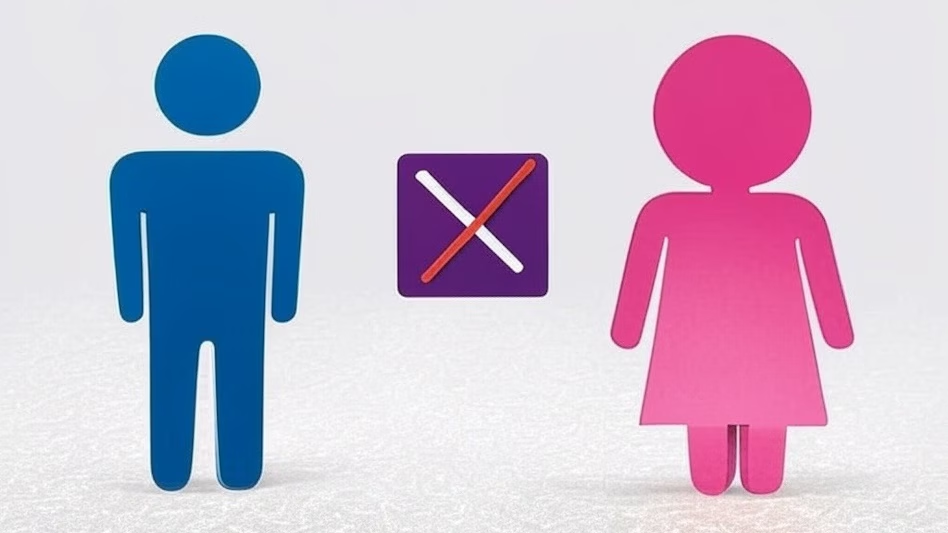
In a significant policy shift, the U.S. Citizenship and Immigration Services (USCIS) has announced that it will no longer offer a third gender option on its forms, aligning with the Trump administration’s stance that recognizes only two biological sexes—male and female. This decision follows an executive order signed by President Donald Trump on his first day back in office, titled “Defending Women From Gender Ideology Extremism and Restoring Biological Truth to the Federal Government.”
The USCIS stated that it is updating the USCIS Policy Manual “to clarify that it only recognizes two biological sexes,” reinforcing the administration’s commitment to policies grounded in biological determinism. Homeland Security Assistant Secretary for Public Affairs, Tricia McLaughlin, emphasized the administration’s stance in a statement, asserting that “President Trump promised the American people a revolution of common sense, and that includes making sure that the policy of the U.S. government agrees with simple biological reality.”
Further justifying the rollback, McLaughlin stated, “Proper management of our immigration system is a matter of national security, not a place to promote and coddle an ideology that permanently harms children and robs real women of their dignity, safety, and well-being.”
The third gender option, previously marked as “X,” was introduced by the Biden administration to accommodate applicants who did not identify strictly as male or female. USCIS had justified this inclusion by acknowledging the barriers faced by individuals who did not fit within traditional gender classifications. At the time, the agency had also noted the administrative challenges posed when birth certificates or other official documents contained a gender designation beyond the traditional male (M) and female (F) categories.
With the updated guidance, USCIS now mandates that an individual’s sex be determined based on the birth certificate issued at or closest to the time of birth. In instances where birth certificates indicate a sex other than male or female, the agency will rely on “secondary evidence” to make a determination.
This policy change represents a broader effort by the Trump administration to align federal governance with a traditional view of gender identity, impacting immigration procedures and reflecting the administration’s broader ideological stance on gender issues.
Recent Random Post: