









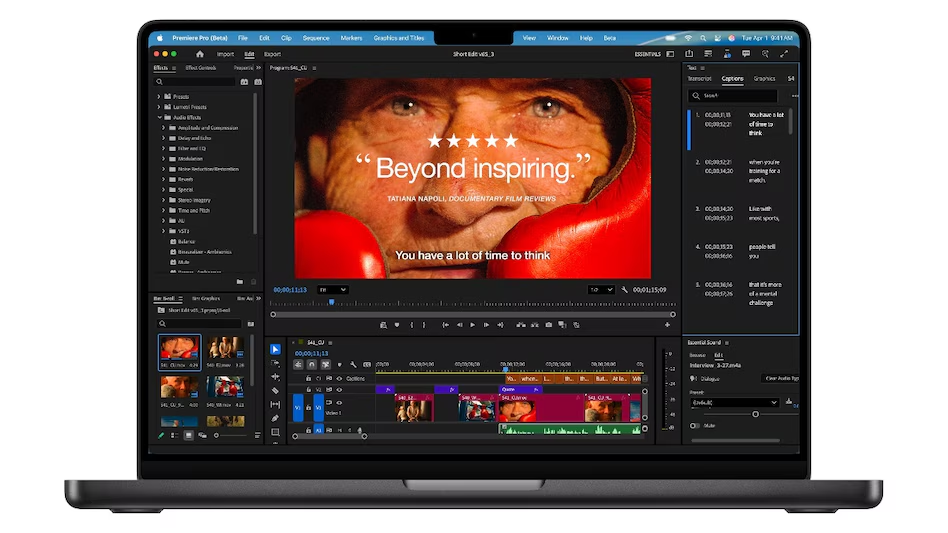
Apple has launched the new 14-inch MacBook Pro powered by its next-generation M5 chip, setting a new standard for AI performance, graphics power, and energy efficiency. The M5 delivers up to 3.5× faster AI performance and 1.6× faster graphics than its predecessor while maintaining an impressive 24-hour battery life.
The new MacBook Pro retains its sleek design, featuring a Liquid Retina XDR display, 12MP Center Stage camera, six-speaker sound system, and macOS Tahoe. Available in space black and silver, it starts at ₹1,69,900 (₹1,59,900 for education), with pre-orders open now and availability beginning 22 October.
“MacBook Pro continues to be the world’s best pro laptop, and today it gets even better with the arrival of the M5 chip,” said John Ternus, Apple’s Senior Vice President of Hardware Engineering. “M5 marks the next big leap in AI for the Mac.”
Built on next-generation Apple silicon, the M5 chip includes a 10-core GPU, a 16-core Neural Engine, and Neural Accelerators in each core. It boosts AI workloads, creative tools, and developer workflows—delivering faster text-to-image generation, large-language model execution, and rendering performance.
Apple claims 2× SSD performance, with configurations up to 4TB. Compared to the M4, users can expect 1.6× faster graphics, 20% faster CPU performance, and full power on battery.
Performance highlights include:
Up to 7.7× faster AI video enhancement in Topaz Video vs. M1
Up to 6.8× faster 3D rendering in Blender
Up to 3.2× higher gaming frame rates than the 13-inch MacBook Pro with M1
Up to 2.1× faster code compilation in Xcode
For Intel and M1 users, the upgrade is even more dramatic—up to 86× faster AI performance and 30× faster GPU rendering with ray tracing.
The Liquid Retina XDR display offers 1600 nits HDR peak brightness and 1000 nits SDR, while the Spatial Audio six-speaker setup enhances immersion.
With macOS Tahoe, users gain a refined design, Live Activities, a new Control Centre, and enhanced Spotlight. The system also supports Apple Intelligence, enabling on-device AI features like Live Translation, enhanced Shortcuts, and generative creative tools.
Developers can now tap into Apple’s Foundation Models framework to build apps with local AI capabilities.
Recent Random Post: