










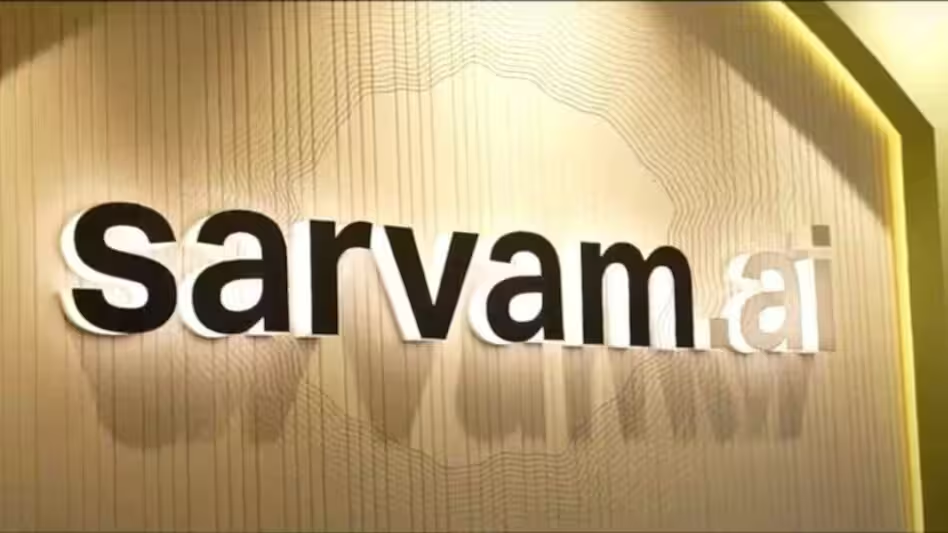
Indian AI startup Sarvam AI is expanding its enterprise operations with a new vertical called “Chanakya,” focused on applied AI solutions for high-impact sectors. The initiative aims to deliver real-world AI systems for governments, enterprises, and critical industries where security, reliability, and sovereignty are top priorities.
In an official post on X (formerly Twitter), the company announced that it has been quietly building full-stack AI capabilities over the past year to address complex and national-level challenges. “Applying our full-stack AI to problems of national consequence and complex enterprises. Now we’re scaling the vertical behind it – Chanakya,” the company stated.
The “Chanakya” platform is designed to operate in secure, air-gapped environments that are isolated from the internet, ensuring maximum data protection. It can process multiple data formats, including text and images, and autonomously execute AI workflows in sensitive, real-world scenarios.
Sarvam AI is targeting organisations that operate outside public cloud infrastructure, particularly those in defence, governance, and other strategic sectors. The system is also described as “dual-use,” meaning it can serve both enterprise applications and national security requirements.
As part of its broader expansion, Sarvam has been strengthening its AI ecosystem with advanced offerings. At the Indian AI Impact Summit 2026, the company unveiled its foundation models Sarvam-30B and Sarvam-105B, which support 22 Indian languages and have shown strong performance compared to global models.
The startup also introduced AI-powered smart glasses called Sarvam Kaze and launched its AI-first application “Indus.” Additionally, Sarvam has joined Nvidia’s Nemotron Coalition, collaborating with global AI firms to develop next-generation open foundation models, marking its growing presence in the international AI ecosystem.




Salman Khan Career Rumors Spark Debate Over Comeback
Reports claiming that Bollywood star Salman Khan’s career is “over” after the film Sikandar have sparked a major debate on social media. Some viral posts suggested that trade analyst Komal Nahta made comments implying that Salman is no longer in demand and that new producers are hesitant to work with him. However, industry circles believe these claims may be misleading or even AI-generated, and that an official clarification from Nahta would help clear the confusion.
Trade experts point out that such negative narratives about a superstar like Salman Khan are hard to accept, given his decades-long dominance and massive fan following. They argue that a few underperforming films do not define the legacy of a legendary actor. In fact, even new-generation stars often receive major opportunities after a single hit, making it unfair to judge veterans by short-term results.
While it is true that Salman Khan has not delivered a major blockbuster in the past few years, industry insiders believe there are multiple ways for him to bounce back. One suggested approach is smarter budgeting strategies, stronger digital and satellite deals, and profit-sharing models where the actor takes a share of the profits instead of a fixed fee, reducing pressure on producers.
Despite recent setbacks, calling his career “finished” is seen as an exaggeration. Salman Khan is reportedly working hard on his next project, Motherland, aiming for a strong comeback. He is said to be giving special attention to the film, with hopes of proving his box office strength once again.
Trade analysts also emphasize that Bollywood’s commercial stability still relies heavily on stars like Salman Khan. His films continuing to perform well is considered important for the overall industry ecosystem. Fans and industry observers alike are now closely waiting to see whether his upcoming projects can deliver a powerful comeback and silence critics once and for all.