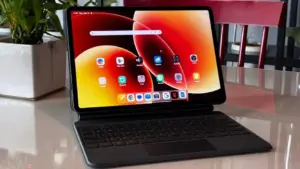
In recent years, tablets have increasingly become a popular alternative to laptops for entertainment and casual work. According to an IDC report, tablet shipments grew by 5% year-over-year to reach 151.9 million units in 2025, reflecting evolving consumer demand. While the market has been largely dominated by Apple’s iPad, Samsung’s Galaxy Tab S series, and the OnePlus Pad series, Xiaomi is emerging as a strong competitor with feature-rich tablets at competitive prices.
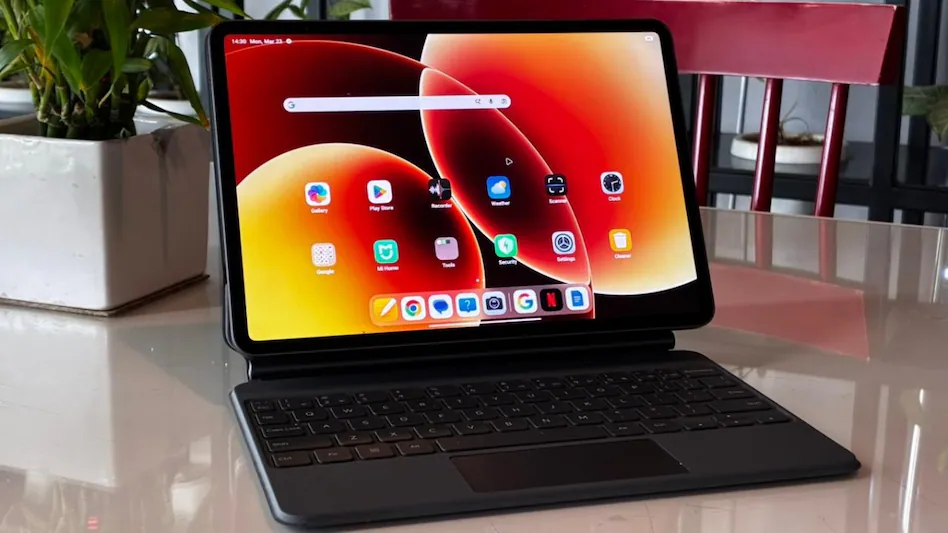
The Xiaomi Pad 8 is a prime example of this trend. The tablet boasts a sleek, lightweight design, a refined software experience, a powerful mid-range processor, and AI-powered features aimed at enhancing productivity. During our 10-day testing, covering display performance, multitasking, and everyday tasks, the Xiaomi Pad 8 consistently delivered a smooth experience.
The Pad 8 feels premium, reminiscent of the iPad Air, aside from the large rear camera module. Measuring just 5.75mm in thickness and weighing 485 grams, it features a full-metal unibody with an aluminum frame and glass front. The rear sports a square-shaped camera module with a ring-shaped LED light. While it lacks a fingerprint scanner and cellular connectivity, it does include a magnetic slot for the stylus. Overall, the design is minimalist and visually appealing.
The tablet sports an 11.2-inch LCD with a 144Hz adaptive refresh rate and up to 800 nits peak brightness. Despite not being OLED, the display offers sharp visuals, accurate colors, and HDR support. A nano-texture coating reduces glare, and touch responsiveness is excellent, though outdoor visibility in direct sunlight is slightly limited.
Audio performance is another highlight. The quad-speaker setup with Dolby Atmos delivers impressive sound quality, enhancing media consumption and gaming experiences.
Under the hood, the Xiaomi Pad 8 is powered by the Snapdragon 8s Gen 4 processor, paired with up to 12GB LPDDR5T RAM and 256GB UFS 4.1 storage. The chipset delivers significant improvements in single- and multi-core performance compared to last year’s model. Daily usage is smooth, with no lag even when multitasking or running multiple apps simultaneously. Gaming performance is also strong, with titles like BGMI and Call of Duty Mobile running smoothly on medium graphics.
The tablet runs Android 16-based HyperOS 3, which provides a clean and refined software experience. The UI is visually polished, with smooth animations, improved multitasking features such as floating windows and split-screen, and a Workstation Mode for a desktop-like experience. AI-powered features such as AI Writing, AI Live Subtitles, Xiaomi Creation, and AI Speech Recognition enhance productivity. Minimal bloatware and an ad-free experience make the software even more user-friendly.
For accessories, the Xiaomi Pad 8 supports the Xiaomi Focus Keyboard and Xiaomi Focus Pen Pro. The keyboard feels premium with comfortable keys and a gesture-supported trackpad, though it lacks a stylus holder. The Focus Pen Pro is ideal for creative work, featuring haptic feedback and gesture controls for functions like double-press, pinch, and twist for stroke adjustments.
The 9,200mAh battery provides a full day of use under medium to heavy workloads. During testing, with up to six hours of screen-on time, the tablet retained about 25% charge at the end of the day. It supports 45W charging but includes a faster 67W charger in the box, fully charging the device in around one hour. The tablet also supports 22.5W reverse charging, allowing it to charge smartphones on the go.
After thorough testing, the Xiaomi Pad 8 emerges as an excellent mid-range Android tablet. It offers flagship-level performance, a responsive and vibrant display, immersive audio, and a clean software experience, all at an attractive price of Rs 33,999. Minor drawbacks such as the camera bump and the absence of an OLED display are easily overlooked in everyday use, making the Xiaomi Pad 8 a compelling and value-packed option.






















Chiranjeevi Faces Social Media Backlash, Jana Sena Defends Him
The ongoing social media campaign targeting megastar Chiranjeevi over his comments on Andhra Pradesh Chief Minister and Telugu Desam Party president N. Chandrababu Naidu has stirred unease within the Jana Sena Party, headed by his brother and deputy chief minister Pawan Kalyan.
Guntur district Jana Sena Party president Gade Venkateswara Rao alleged on Monday that the criticism was politically motivated, suggesting that TDP supporters might be behind the negative campaign. He accused certain groups of deliberately spreading misinformation and cautioned against provocative commentary.
“Everyone knows who is behind these campaigns. We are maintaining restraint only because of coalition dharma,” Venkateswara Rao said, urging critics to avoid inflammatory remarks.
The controversy arose from Chiranjeevi’s remarks at the Gaddar Awards in Hyderabad, where he suggested that Andhra Pradesh could do more to support the film industry and recommended hosting state-level film award events. Defending Chiranjeevi, Venkateswara Rao emphasized that there was nothing objectionable in referring to Andhra Pradesh as a “neighboring state” or offering constructive suggestions for the development of the film sector.
He also reminded critics of the party’s past sacrifices, stating, “When Pawan Kalyan called us to action, we responded and even faced legal cases. Where were these critics then?” While reaffirming commitment to alliance discipline under Pawan Kalyan, he stressed that defamatory campaigns would not be tolerated. “Being in an alliance does not mean we will remain silent on every issue,” he added.