









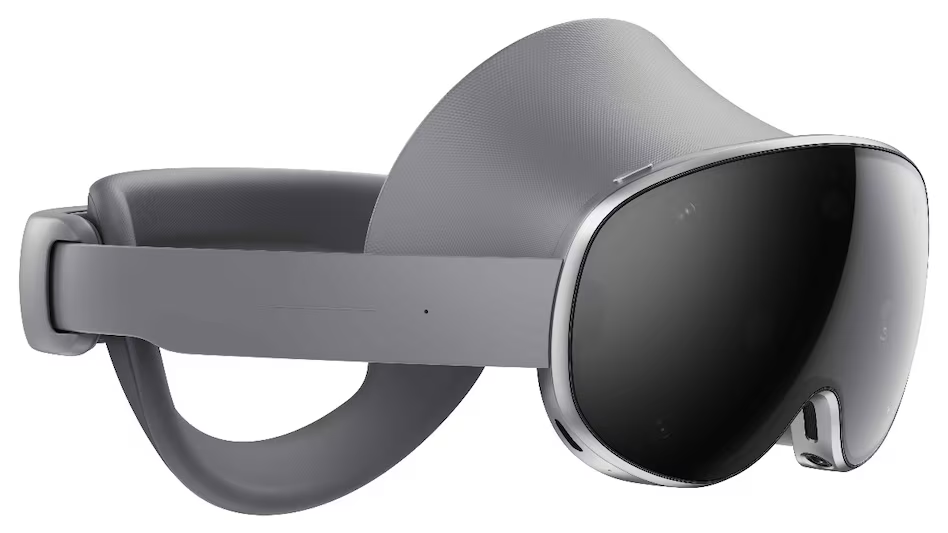
Samsung has officially unveiled the Galaxy XR, a groundbreaking AI-native headset that marks the beginning of the Android XR ecosystem, developed in partnership with Google and Qualcomm Technologies. Announced in Seoul, the Galaxy XR aims to redefine immersive experiences across work, entertainment, and exploration.
As the first device built on the new Android XR platform, Galaxy XR seamlessly combines artificial intelligence and extended reality (XR) to deliver natural, intuitive interactions through voice, vision, and gestures. The launch represents Samsung’s first step in its long-term XR roadmap, which will also include AI-powered smart glasses and other connected wearables.
“With Galaxy XR, Samsung is introducing a brand-new ecosystem of mobile devices,” said Won-Joon Choi, Chief Operating Officer of Samsung’s MX Business. “Built on Android XR, Galaxy XR expands the vision for mobile AI into a new frontier of immersive and meaningful possibilities.”
Sameer Samat, President of Android Ecosystem at Google, emphasized that Android XR is the first Android platform “built entirely for the Gemini era,” enabling an open and unified environment for the next phase of computing. Alex Katouzian from Qualcomm Technologies added that Galaxy XR represents the convergence of AI and XR, unlocking powerful new use cases for both consumers and industries.
Powered by the Snapdragon XR2+ Gen 2 chipset, the Galaxy XR delivers advanced graphics, spatial computing, and on-device AI via the Qualcomm Hexagon NPU. The headset features 4K Micro-OLED displays, spatial audio, and advanced sensors for tracking head, hand, and eye movements with precision. A separate battery pack improves balance and comfort, while a detachable light shield allows users to switch between immersive and mixed-reality modes.
Integrated with Gemini AI at the system level, the Galaxy XR interprets surroundings and responds naturally, creating fluid, human-like interactions. It supports existing Android applications and adheres to OpenXR standards, enabling developers to adapt apps built on OpenXR, WebXR, or Unity for seamless cross-platform compatibility.
Beyond entertainment, Samsung is positioning the Galaxy XR for enterprise use, collaborating with Samsung Heavy Industries on virtual shipbuilding training and productivity solutions. The headset also integrates with Snapdragon Spaces for enterprise-grade design, training, and remote collaboration tools.
Users can experience immersive applications such as 3D Google Maps navigation, YouTube gesture controls, and 3D photo and video transformation, bringing both productivity and creativity into extended reality.
Looking ahead, Samsung plans to expand the ecosystem with AI-powered smart glasses, developed with Google and leading eyewear brands including Warby Parker and Gentle Monster, blending style with cutting-edge XR functionality.
The Samsung Galaxy XR will be available starting October 21 in the U.S. and October 22 in Korea.
Recent Random Post: