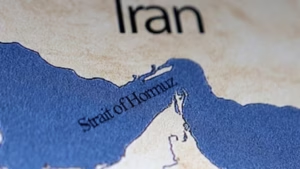
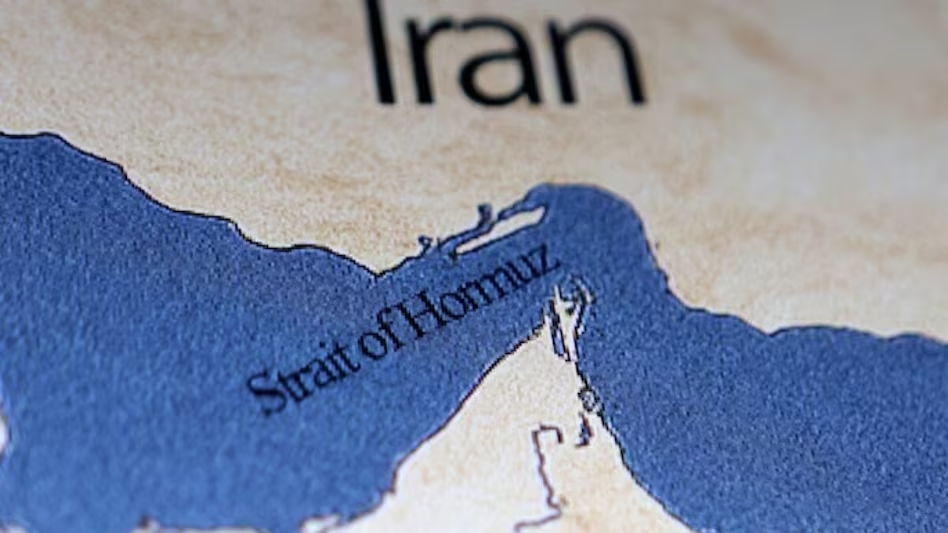
Gulf countries are reportedly revisiting plans for expensive pipeline projects designed to bypass the Strait of Hormuz, amid growing concerns over long-term geopolitical risks and the possibility of prolonged Iranian influence over the strategic waterway. These pipelines are seen as critical to ensuring uninterrupted oil and gas exports, despite high construction costs, political sensitivities, and lengthy execution timelines.
According to a report by the Financial Times, Saudi Arabia’s 1,200 km East-West pipeline—originally built in the 1980s during the Iran-Iraq tanker conflict—continues to play a vital role in the kingdom’s export strategy. The pipeline transports nearly 7 million barrels of oil per day to the Red Sea port of Yanbu, allowing Saudi Arabia to completely avoid the Strait of Hormuz. Saudi Aramco CEO Amin Nasser has also confirmed that this remains a key export route for the kingdom.
Saudi Arabia is now exploring options to further strengthen pipeline-based exports instead of depending heavily on the Hormuz route. This includes potential expansion of the existing East-West pipeline and the development of new alternative corridors, according to the report.
In addition to oil-focused infrastructure, long-term pipeline projects are also being considered as broader trade corridors for goods beyond energy. One proposal involves reviving the US-backed IMEC corridor linking India to Europe via the Gulf region, although political complexities remain, particularly regarding routes passing through Israeli ports such as Haifa. Israeli energy executives, including NewMed Energy CEO Yossi Abu, have expressed confidence in the feasibility of connecting regional pipelines to Mediterranean export points through Israel or Egypt.
However, experts caution that major challenges remain. Construction costs for such projects are estimated at around $5 billion for expanding existing routes, while multi-country pipelines could cost between $15–20 billion. Additional concerns include security risks, militant threats, and political instability across transit regions such as Iraq, Jordan, Syria, and Turkey.
Near-term solutions may include expanding Saudi Arabia’s East-West pipeline and Abu Dhabi’s existing Fujairah pipeline to boost capacity without complex cross-border arrangements. Saudi Arabia is also reportedly considering new export terminals along its Red Sea coast, including facilities linked to the NEOM project.
Meanwhile, the United Kingdom is leading discussions among 35 countries to form a coalition aimed at reopening the Strait of Hormuz. Despite these efforts, analysts believe Gulf nations are preparing for long-term structural changes in global energy routes rather than expecting a return to the pre-crisis status quo.





















Prakash Raj Responds to Funeral Controversy
Versatile actor Prakash Raj has landed in the middle of a social media controversy after attending his mother’s funeral service at a church. The backlash stems from his long-standing stance as an atheist and his past criticism of religious practices, particularly those associated with Sanatana Dharma.
Over the years, Prakash Raj has often voiced strong opinions on religion and has even taken indirect jabs at public figures like Pawan Kalyan when they shared posts related to Hindu beliefs. This history has now led some users online to question what they see as a contradiction—attending a church service while criticizing others for their faith.
Responding to the criticism, Prakash Raj took to Twitter to clarify his stance. He wrote, “Yes. I don’t believe in god .. but my mother believed in her god. Who am I to deny her the right to be buried according to her belief. This is the basic respect we give one another. Will you hate-mongering monsters understand this #justasking.”
His supporters quickly rallied behind him, praising his response and stating that he had strongly addressed the trolls. Some even alleged that politically motivated groups were behind the criticism, accusing them of being intolerant toward differing viewpoints.
However, the debate didn’t end there. A section of users pushed back, arguing that while he respects his mother’s beliefs, he has often mocked the faith and traditions of others. This ongoing exchange has turned the issue into a broader discussion on social media about personal beliefs, mutual respect, and public accountability.