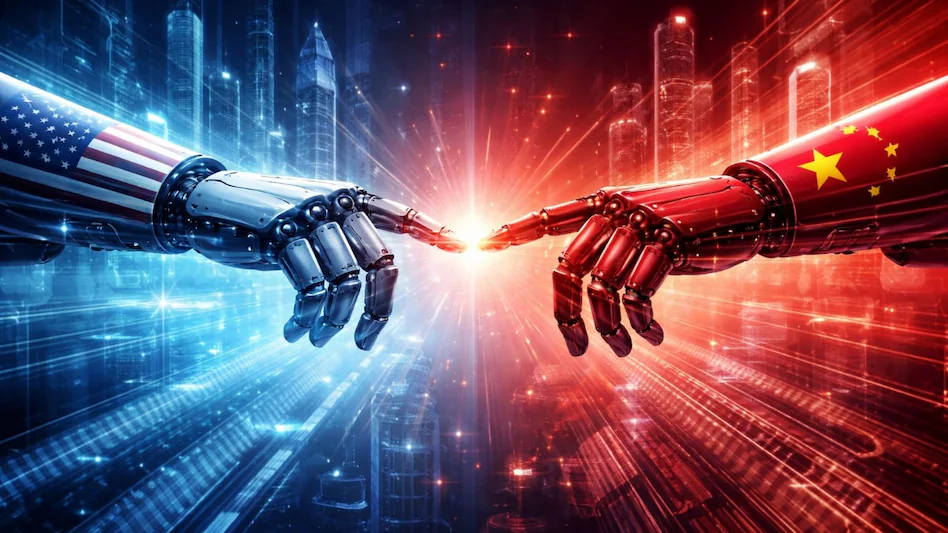
The gap between American and Chinese artificial intelligence capabilities has effectively disappeared, according to the 2026 AI Index report by Stanford University. Once seen as a major strategic advantage for the United States, this lead has now narrowed to the point where both countries are competing almost neck and neck.
The report notes that AI models from the US and China have been exchanging the top position multiple times since early 2025. For instance, China’s DeepSeek-R1 briefly matched leading US systems in 2025, while by March 2026, a top model from Anthropic was ahead by a slim margin of just 2.7%. This marks a significant shift from earlier years when US firms clearly dominated advanced AI development.
Despite the narrowing gap, both countries still have distinct strengths. The United States continues to lead in building cutting-edge AI models and securing high-impact patents, largely driven by a handful of powerful private tech companies. In contrast, China has taken the lead in overall research output, including publications, citations, patent filings, and industrial robotics.
The difference reflects two contrasting approaches. The US model relies on a few major private labs pushing the boundaries of innovation, while China focuses on scale, with widespread contributions from universities, companies, and state-backed initiatives.
In 2025 alone, the US developed around 50 major AI models compared to China’s 30, maintaining an edge in frontier technologies. However, China is rapidly catching up in research influence. It accounted for over 74% of global AI patents in 2024, a dramatic rise, while the US share has dropped significantly over the past decade. China also leads in research publications and citations, indicating growing influence in the academic AI space.
At the same time, the US still dominates in private investment, with nearly $286 billion invested in AI in 2025—far exceeding China’s disclosed figures. The US also leads in startup activity, creating nearly 2,000 new AI companies in a single year.
Overall, the report highlights a shifting global landscape where the US and China are now closely matched in AI capabilities, each leveraging different strengths. While the US remains strong in innovation and funding, China’s scale and research momentum are rapidly closing the gap, reshaping the future of the global AI race.