









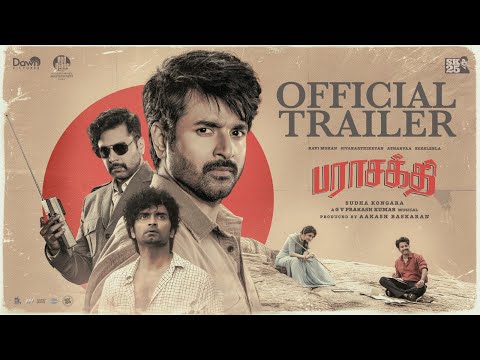
Tamil star Sivakarthikeyan’s upcoming film Parasakthi is gearing up for a Pongal festival release, with the makers unveiling the much-awaited trailer on Sunday evening. Directed by Sudha Kongara, the period drama promises a gritty, action-packed narrative rooted in political history, with a strong thematic focus on Hindi imposition.
While the Tamil trailer has generated significant buzz, the absence of a Telugu version has raised eyebrows. This is particularly surprising given that the film stars popular Tollywood actress Sree Leela as the female lead and considering Sivakarthikeyan’s growing market in the Telugu states.
Earlier reports suggested that Parasakthi would release simultaneously in Telugu, despite stiff competition during the crowded Sankranti season. The team had also released promotional material in Telugu to build anticipation among audiences in Andhra Pradesh and Telangana. However, the sudden silence over the past few days has sparked speculation about a possible change in strategy.
Industry circles suggest that the jam-packed festive lineup in Tollywood may have prompted the makers to reconsider a Telugu release during Sankranti. With most screens expected to be dominated by straight Telugu releases, and the remaining ones likely to be taken by Vijay’s Jana Nayakudu, securing adequate screen space for a dubbed film could be challenging.
As a result, Parasakthi may opt for a delayed Telugu release after the Sankranti festival. However, even in Tamil Nadu, the film faces formidable competition from Jana Nayagan, directed by H. Vinoth. The Vijay starrer is riding massive hype, further amplified by the fact that it marks the actor’s final on-screen appearance.
Whether Parasakthi can carve out its own space amid these high-stakes releases remains to be seen, but the trailer has certainly set the stage for an intense political drama this festive season.






Rayalaseema Lift Project Controversy Reignites Political Tensions
The Rayalaseema Lift Irrigation Project has once again come into political focus following recent remarks by Telangana Chief Minister Revanth Reddy in the Assembly. His comments were swiftly amplified by the YSR Congress Party (YSRCP), which accused the ruling TDP-led coalition government in Andhra Pradesh of neglecting Rayalaseema’s irrigation needs.
Rejecting these allegations, the Andhra Pradesh government has termed the criticism politically motivated, stating that the controversy surrounding the project predates the current administration and is rooted in procedural lapses during the previous YSRCP regime.
According to officials from the state government and the irrigation department, the Rayalaseema Lift project was initiated without obtaining mandatory statutory and environmental clearances. As early as 2020, multiple central agencies and regulatory authorities had reportedly directed that no construction work should proceed without prior approvals.
Despite these warnings, the project was announced and work was taken up, eventually leading to legal hurdles. Government sources point out that stop-work orders were issued by institutions such as the National Green Tribunal (NGT) and river management authorities well before the present coalition assumed office. Officials also note that project execution had already slowed and later stalled during the YSRCP tenure due to the absence of clearances.
The current NDA-led coalition argues that the previous government failed to effectively defend the project in legal forums, weakening Rayalaseema’s position. In contrast, the present administration says it has begun filing detailed counters and placing factual submissions before the NGT in an effort to revive the project through lawful and sustainable means.
At the same time, the government has highlighted a renewed focus on Rayalaseema’s irrigation and agricultural development. Officials claim irrigation spending in the region declined significantly over the past five years, while the current government has increased allocations and revived stalled works. Priority is being given to projects such as the Handri Neeva canal expansion, reservoir strengthening, micro-irrigation initiatives, and drip irrigation subsidies to directly benefit farmers.
The government further states that its long-term objective is to transform Rayalaseema into a horticulture- and irrigation-driven region by enhancing water storage, ensuring efficient distribution, and executing projects in compliance with legal and environmental norms.
Maintaining that the Rayalaseema Lift controversy stems from past administrative failures, the AP government has accused the YSRCP of using recent political statements to deflect responsibility. The NDA coalition asserts that it is now focused on correcting those errors while rebuilding trust among farmers in the drought-prone Rayalaseema region.