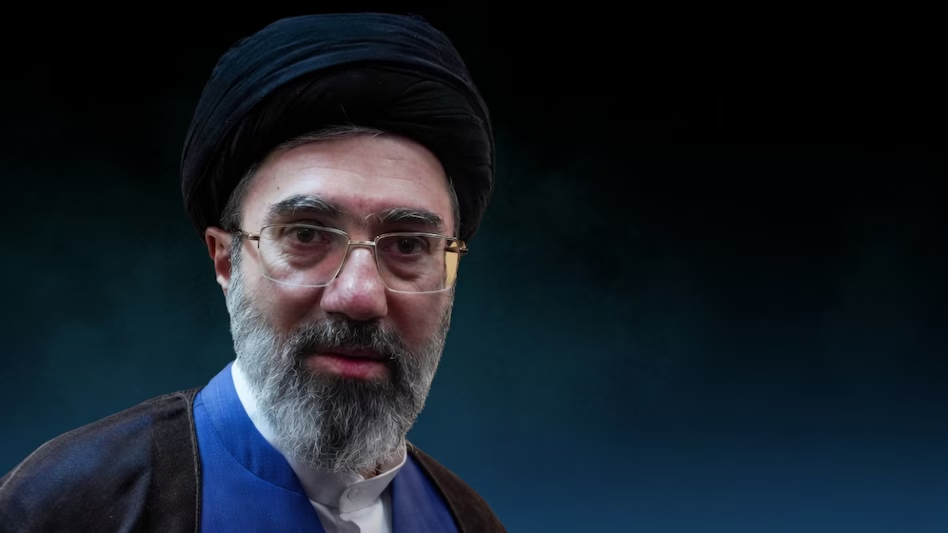
Reports have emerged regarding Mojtaba Khamenei, son of Iran’s former Supreme Leader Ayatollah Ali Khamenei, amid ongoing speculation about the country’s leadership structure following recent turmoil. His whereabouts and prolonged absence from public view have raised questions, although Iranian officials have dismissed concerns about his health.
According to a report by The New York Times, Mojtaba Khamenei is reportedly severely injured but remains mentally alert and actively involved in decision-making. The report claims he has undergone multiple surgeries, including three operations on his leg and surgery on one hand. It also states that he suffered serious facial injuries, including burns to his face and lips, which have affected his ability to speak. He is said to be awaiting further medical treatment, including possible plastic surgery.
Due to his condition, Mojtaba has largely avoided public appearances, reportedly preferring not to appear vulnerable. Instead, he is said to communicate through written messages that are read out on television or shared online. These messages are reportedly delivered through a tightly controlled chain of couriers.
The report also highlights a shift in Iran’s internal power structure. It claims Mojtaba has delegated key decision-making responsibilities to senior military figures, particularly within the Revolutionary Guards. One Iranian politician described his role as “managing the country like a board director,” with generals acting as board members.
Following the reported death of Ayatollah Ali Khamenei, a leadership vacuum is said to have emerged, leading to internal consolidation of power within the Revolutionary Guards. However, analysts suggest that Mojtaba’s authority remains closely tied to, and possibly dependent on, the military establishment.
Key figures reportedly involved in this power structure include Brigadier General Ahmad Vahidi, General Mohammad Bagher Zolghadr of the Supreme National Security Council, and military adviser General Yahya Rahim Safavi. Some experts, including Ali Vaez of the International Crisis Group, argue that Mojtaba does not hold absolute authority and remains subordinate to the Revolutionary Guards.
The report further notes that Iran’s foreign policy apparatus has undergone changes, with Foreign Minister Abbas Araghchi reportedly sidelined. Instead, Parliament Speaker Mohammad Bagher Ghalibaf is said to be taking a more active role in negotiations with the United States.
Additionally, close associates of Mojtaba, including cleric Hossein Taeb and General Mohsen Rezaei, have reportedly been brought back into advisory roles, strengthening the influence of veteran military-linked figures.
Despite concerns over central leadership, the report suggests that Iran’s military establishment remains largely unified, with no visible signs of internal disarray at present.